Category: Analog Living

    A merry loner doesn’t need to be constantly plugged in. We value real life over virtual noise and prioritize presence over performance. Get inspiration to step back from the screen with analog habits and screen-free activities that remind you how to live a life offline.

    • How to Quit Social Media

      How to Quit Social Media

      Because life after social media is lighter, richer, and just more enjoyable

      It’s not easy to put down the phone. For many of us, it has almost become an extension of ourselves. Some people even carry it on a chain around their neck or attach a micro version to their wrists. Most of us can’t leave the house without it—and our heart stops when we think we’ve misplaced it. 

      It’s not our fault. The phone is shiny, expensive, alluring. And companies are literally spending millions of dollars to keep us hooked. You know which ones: social media companies. 

      Facebook. Instagram. Snapchat. Dare I say, TikTok. The bad boys patrolling the Internet, luring you in with funny memes and clickbait—and then making off with your time, money, and in many cases, self-esteem. 

      It wasn’t always like this. When many of us created our first social media accounts, we were doing it to stay in touch with friends and share family photos, i.e., connect with others. 

      Now, most of that connection is lost. Most days, our algorithm feeds us rage-bait that spikes our blood pressure and makes that pit in our stomach grow tenfold. (You know, that old friend, existential dread.) On top of that, it pushes unrealistic and unattainable standards for beauty, wealth, and everything in between that leave us doubting ourselves, at best, and hating ourselves, at worst. 

      And of course, advertisements. Everywhere, all the time, popping up and flashing with all sorts of different sounds. Because even though it’s never worked before, maybe buying this one very specific next thing will bring us that unattainable happiness we’ve long strived for. 

      Sound familiar? 

      As depressing and hopeless as it can feel sometimes to live an increasingly digital world, we do have a choice: We can disconnect. We can stop using social media.

      I don’t mean forever. I still use Facebook Messenger to talk to my friends. I share my writing on Instagram and Pinterest. I like logging into Facebook every few months and seeing my old co-workers share updates about traveling or getting married or having kids.

      But we can choose to use social media in a way that serves us, instead of letting it abuse us. I’ll show you how—or at least what’s worked for me.

      The shortlist: How to stop using social media

      5 strategies to stop using social media (without deleting your accounts)

      Productive apps instead of social media to help you replace the urge to scroll

      Substitutes for social media, whether you use social media to connect with others, relax, be entertained, or follow the news

      Understanding why it’s so hard to stop using social media (it’s not your fault)

      4 steps to quit social media that worked for me

      How to quit social media (without deleting your accounts): 5 strategies

      Often, people are hesitant to even attempt quitting social media because they don’t want to give it up cold turkey. That’s fair. But you can still get the benefits of quitting social media by just scaling back a little bit. 

      It may seem difficult at first, but once you get the ball rolling, cutting social media out of your life gets easier and easier. That’s because habits are hard to break. But if you can reorganize your day so you have less soul-sucking options within reach the next time you get the urge to scroll, then you can slowly replace your social media habit with much healthier, more productive, and more enjoyable activities. 

      Wait, why are habits so hard to break? 

      Dopamine levels spike when an action gets “rewarded,” e.g., like seeing a funny meme after scrolling through your feed for 20 minutes.

      Once an action becomes a habit, simply initiating the action gives us a dopamine hit, even if there’s no reward, i.e., you still get a dopamine hit when you scroll your phone, even if you don’t see anything funny or useful. 

      SOURCE: McGovern Institute

      These are five strategies I found helpful to get rid of social media’s outsized presence in my life:

      1. Put your phone in the other room as often as you can

      When something is too tempting, get rid of the temptation altogether. 

      Of course, this tip isn’t practical all the time, especially when you’re on the go. But when you’re at home it’s totally doable and a really easy way to rid yourself of the lure of the phone. 

      But just putting your phone in another room isn’t enough. Because we have legs. And when our willpower is weak and we let the bad thoughts win, it’s too easy to allow ourselves a quick moment to “just check in” when we’re passing by. 

      So set a timer. I like to use intervals of 45 minutes. I put my phone in the other room and set a timer for 45 minutes. When the buzzer sounds, I’m allowed to check my phone and see if any interesting notifications popped up while I was away. 

      In most cases, however, I’ve usually become engrossed in another activity in those 45 minutes and no longer feel the pull to see what strangers on the Internet are doing.

      How to fill the time without social media? 

      The possibilities are literally limitless, which means it can sometimes be hard to think of them. 

      I’ve given you a cheatsheet. Read What to Do Instead of Social Media for 34+ ideas.

      2. Delete social media apps from your phone—but not your account

      This is how I kicked my habit of needlessly scrolling Instagram and Twitter (and even LinkedIn). 

      I never considered LinkedIn a social media app; I just had it because of work. But once I deleted Instagram and Twitter from my phone, the demon inside me needed something else to scroll, and LinkedIn fit the bill. 

      I had made one of the classic mistakes of trying (and thus failing) to break bad habits: I never replaced the bad habit with a good one. Sure, I had eliminated Instagram from my life, but I hadn’t developed a substitute to fill on-the-go scrolling time. Unbeknownst to me, LinkedIn was waiting in the wings to fill its place. 

      The “professional” social media app has since been banned from my phone, along with all other apps even remotely capable of scratching the scrolling itch. Since then, my screen time has shrunk dramatically; I now average only about 1.5 hours on my phone per day. 

      (Not to brag, but American adults’ average screen time is 5.25 hours a day. Where do you stand?)

      3. Set up website blockers on your computer

      Without social media apps on my phone, clever little me soon found a solution: the computer. 

      Though I’d never done it before, Instagram and Twitter became frequent mainstays on my laptop screen. Here, the temptation was even worse. While staring at my screen all day long during work hours, it was far too tempting (and easy) to open a new tab and dive headfirst into the bowels of Instagram and Twitter content—just to give myself a “5-minute scroll break” after completing an hour or so of deep work. 

      This bad habit plagued me for several months, until I realized that I hadn’t stopped using social media any less. I had simply switched devices. 

      Thus, up went the website blocker. (I like LeechBlock.) You can configure these website blockers to work on a timer, barring access to a certain site and then letting you through after a certain time frame has passed (e.g., one hour) or time of day has arrived (e.g., 6:00 pm). 

      For me, this wasn’t enough. (Though for you, it might be.) I wanted to kick my social media habit altogether, so I completely banned Instagram and Twitter from my laptop. I allow myself to check in occasionally, but to do that, I have to type in a master password—and face my shame. 

      This was really the nail in my social media coffin. When I tried to go to the Instagram page, I was faced with a white screen with the message I wrote to myself: “Live your life.” This gave me an equal mix of inspiration and shame, pushing me to close the tab—and scarcely return.

      4. Use a phone brick

      Another option to stop using social media without deleting it, but not one I’ve tried myself. Honestly, I feel like this is a bit of a Band-Aid solution. Instead of buying something to curb my social media habit, I’d rather work on retraining my brain to not desire the scroll at all. 

      That said, I know some people who have tried the phone brick trick, and it’s helped them use social media less. So by all means… Here’s how it works: 

      • Download and configure the Brick app.

      • Connect your phone to the Brick device.

      • In the app, choose which apps you want to “brick,” i.e., Instagram, Facebook, TikTok.

      • When you’re ready to leave the house, start work, or relax for the evening, tap your phone to the Brick device to “brick” it. This means those “bricked” apps will be completely inaccessible until you “un-brick” your phone. 

      • When you’re ready to come back online, tap your phone to the Brick again to “un-brick” it.

      Unlike analog methods, the brick doesn’t rely on willpower alone (which, let’s face it, is stronger some days than others). If you’re tried other methods to stop using social media but nothing seems to be helping, a phone brick may be the extra kick in the pants you need to stop the Instagram scroll. 

      5. Replace the urge to scroll with something else

      If you want to figure out how to quit a social media addiction, you can’t simply eliminate social media from your life. You need to find alternatives to fill that space. 

      There’s a lot you can do. I wrote an entire blog post giving you options on What To Do Instead of Social Media, including ideas to replace social media: 

      • When you wake up

      • When you eat

      • During your commute

      • At night

      • When you have just a few minutes to fill 

      • When you need to zone out

      And many, many other scenarios we modern-day humans find ourselves in. 

      Of course, there are near infinite ways to fill your free time, but social media fills a particularly niche space of time. Usually, we tend to scroll when we’re waiting for things—when we have just a few minutes here or there—so regular hobbies like exercising or drawing won’t always work. 

      The trick is finding social media replacements that replace your urge to scroll and that you can do anytime, anywhere. 

      Productive apps instead of social media

      That’s why I like thumbing through these productive apps instead of social media. Sure, they keep you on your phone—but if you really feel the need to stare at your device while waiting in line at the grocery store, these are much better alternatives to TikTok: 

      • Duolingo: Are you going to become fluent in a new language simply by using Duolingo? Of course not. But that doesn’t mean it’s not a useful tool. I’ve personally learned how to order coffees, ask for directions, and even communicate with some security guards when I got lost and accidentally trespassed in Kraków. Even if it’s not perfect, 10 minutes spent learning some new foreign language vocabulary is always better than 10 minutes of TikTok brain rot.

      • Wikipedia: Did you know Wikipedia has an app? It makes getting lost in Wikipedia rabbit holes even more fun. And even if you don’t have time for an entire reading spiral, it’s pretty entertaining to open the app and browse the most-read articles that day, daily historical events, and other trivia tidbits. (Again, always better than brain rot.) 

      • Calm: This is probably my most-used app—and the only app I’ve ever paid for. I won’t extol the benefits of meditation here, but I highly encourage you to give it a whirl if you’ve never tried before. For a free option, the U.S. Department of Veteran Affairs offers the Mindfulness Coach App (free for everyone, even if you’re not a veteran) with different mindfulness exercises you can use to replace some scrolling time. 

      • eBooks: I know reading isn’t exactly the same as scrolling, but it is infinitely better for you. If you’re not already a bookworm, remember this trick: You don’t have to read serious, high-brow books to be a reader. Science fiction, fantasy, romance novels—it all works. As I always say: “Ten minutes spent reading a crappy novel is always better than 10 minutes spent watching TikToks.” 

      • Learn Geography: ICYMI, the theme here is taking scrolling time and making it productive. With this app, you still get a few minutes of playing on your phone—but instead of scrolling past advertisements or getting riled up about the state of politics, you can learn something new about the world. Isn’t that always nice?

      Substitutes for social media

      It’s hard to break a bad habit if you don’t have anything to replace it with. And I get it—even if you dramatically scale back on your social media use, you still want ways to connect with your friends, unwind after a long day, entertain yourself and stay up to date with what’s going on in the world. 

      But you don’t need social media to do those things. Try these replacements for social media instead:

      If you use social media to connect with others…

      Try voice memos or phone calls. I know phone calls seem scary nowadays, but as social isolation and loneliness tighten their grip on societies around the world, we need to make more effort to stay connected with each other. If calling a friend out of the blue still feels weird to you, start with voice memos. Ask if you can schedule a weekly catch-up call. And if you really don’t know where to start, call your grandma. She’ll love it.

      Write a letter or an email. Ditto with the long-form correspondence. Yes, text messages are quick and convenient, but a short “How are you?” SMS (no matter how heartfelt) is no replacement for an actually substantive exchange. If it’s too hard to schedule phone time with long-distance friends or family, how about becoming pen pals? Emails are a fun 2000s throwback, but if it feels too office-y for you, why not get into letter writing? Just a few lines will do—and who doesn’t love getting a postcard in the mail? 

      Share photos in group chats. “But what about my vacation pictures?” I know. The universe will cease to exist if everyone can’t see your beach selfies from Greece. I get it: People want to share their lives with their loved ones, but when did the whole world suddenly become part of the conversation? Instead of blasting to Instagram, how about sharing photos in a group chat? The connection is still there, and Zuckerberg has no place in it.

      If you use social media to relax…

      Use a meditation app for a quick fix. After a long day or an intense session of socializing, it can feel good to veg out and empty your mind with a little social media scrolling. But does it really make you feel relaxed afterward? Or does it give you FOMO, stress, or anxiety. Next time, try replacing 10 minutes of Instagram with a 10-minute guided meditation. That’s actual stress relief.

      Keep a coloring book handy. Coloring isn’t just for the kiddos. A study published in Animal Models and Experimental Medicine looked at coloring as a supplement to conventional drug therapy and physical therapy and found coloring therapy “can not only reduce depression and negative emotions but also have better effects on reducing anxiety and improving positive emotions than conventional therapy.” Can doom-scrolling do that? (It can’t.)

      Start listening to audiobooks. At the end of a long, tiring day, I know reading isn’t always a favorite way to unwind. Especially if you spent the whole day looking at the screen, it’s nice to give your eyes a bit of a break. That’s why I’ve been getting audiobooks lately: hands-free reading that nourishes your mind instead of dulling it.

      If you use social media for entertainment…

      Watch a show or a movie—without multi-tasking. According to mntn research, “83% of American TV watchers use a second device while watching TV.” Seriously? We can’t even just watch TV now? We’re that addicted to scrolling? Next time you want to unwind with a TV show, actually let your mind unwind. Put down the second screen. Stop trying to multi-task. And let your brain find some kind of stillness. The show is entertaining enough. 

      Play a card game. I’m partial to solitaire—a lot, actually. I find it incredibly relaxing. It keeps your hands busy. It’s methodical. And it uses just enough brain power to keep you engaged so you can quiet your mind and stop yourself from overthinking about everything that happened that day. I also love solitaire for a quick, 5-minute break away from the screen in the middle of the workday.

      Read something light. I’m a classic novel fiend as much as the next person, but I’ll be honest: I don’t necessarily want to curl up with Crime & Punishment at the end of a long day when my eyes are already tired. That doesn’t mean no reading has to take place—and there’s no shame in turning to a good beach read. A light book I devoured recently? Cleopatra & Frankenstein by Coco Mellors.

      If you use social media for the news…

      Subscribe to a few vetted email newsletters. This way, you get what you need without unnecessary advertisements or the algorithm distracting you with flashing promotions or annoying videos. Morning Brew is a great standby for the quick highlights. And I’ve been a long-time lover and subscriber of The Economist since college.

      Ditch the scroll and read directly in news apps. I actually prefer this to newsletters. Once you start subscribing to a lot of newsletters, they can clog up your inbox fast—and that just adds a whole new layer of stress to my daily life. I don’t want that. But with a news app, I can pop in when I feel like reading. Any other time of day, the news is out of sight, out of mind.

      Buy physical magazines or newspapers. My holy grail—and one of my favorite ways to make life more analog. No videos randomly playing in the background. No screen burning your eyes. No slop pushed in from the algorithm. It’s a much more relaxing way to stay informed, and one of the best ways to support quality media outlets and journalists.

      Why is it so hard to stop using social media?

      If you’ve tried getting rid of social media before and always failed, don’t be too hard on yourself. There are literally teams of people and hundreds of millions of dollars at work trying to keep you hooked. And that’s just the tip of the iceberg. 

      By better understanding your reliance and/or addiction to social media, it’s easier to come up with strategies to beat the bad habit.

      These are a few likely reasons you may keep coming back to the monsters:

      1. It’s designed to be addictive

      “Behind every screen on your phone, there are generally like literally a thousand engineers that have worked on this thing to try to make it maximally addicting,” former Mozilla and Jawbone employee Aza Raskin told the BBC back in 2018. 

      While this article condemning social media companies for “deliberately addicting users to their products” was written eight years ago, I think it’s safe to say things have gotten even worse since then, especially with AI new on the scene. 

      A 2025 review article published in Cureus explores social media algorithms’ addictive nature and its neurophysiological effect on teenagers’ brains, noting “AI-driven social media algorithms are designed to solely capture our attention for profit…”

      Basically, if you feel like you can’t get away from the screen, no matter how hard you try, it’s not your fault. Giving up social media is really difficult on purpose, so if you find yourself slipping back on your goals, go easy on yourself. 

      And then get back at it and try again.

      Do you want to learn more about how the tech overlords keep us addicted to social media? 

      Knowledge is power. I highly recommend this book from Adam Alter: Irresistible: The Rise of Addictive Technology and the Business of Keeping Us Hooked.

      2. Everyone else is on it

      The Digital 2026 Global Overview Report from We Are Social gives us the latest numbers: 5.66 billion people use social media. That’s a sobering number. Out of the 8.2 billion people on the planet, something like 70% of them have social media accounts. 

      Understandably, getting off social media can feel like stepping away from our social network—and nobody wants to feel left out. But we all had friends before we created our first Facebook accounts. Actually, we had more. In a survey from the Survey Center on American Life, 49% of Americans say they now have three or fewer close friends. That’s up from only 27% in 1990. 

      You don’t need social media to stay connected with your friends, though it may seem like the default these days. Instead, you can: 

      • Send text messages

      • Talk on the phone

      • Become email pen pals

      • Exchange letters

      • Record voice memos

      All a lot more personal and heartfelt than any “like” or (God forbid) AI-written comment.

      3. We don’t let ourselves get bored anymore

      When there’s an empty moment, anywhere, we can immediately fill it with image and sound because we almost always have access to a phone and thus anything our little hearts desire.

      Often, it seems that desire is to scroll through Reels, advertisements, and overly romanticized, highly edited “inside looks” at other people’s lives. This shouldn’t be as normal as it is, and it’s a shame we’ve reached this point because, believe it or not, boredom is where the magic happens. 

      Boredom is where you let yourself ponder, think the big thoughts, and come up with new ideas.

      Liraz Margalit Ph.D. for Psychology Today explains it well: “People who allow themselves to be bored and are not afraid to be with themselves and their thoughts think more creatively than those who do not experience boredom.”

      But for many of us, boredom has become foreign territory. 

      Standing in line at the grocery store. Riding the metro. Waiting for a friend to join you at the coffee shop. All moments where we could observe our surroundings, let the mind wander, and just generally be at ease with our own company. But we never let it happen, because we immediately reach for the phone to fill those moments with the scroll and, in doing so, extinguish any sparks of creativity before they can ignite.

      Learn how to do things alone—without feeling lonely

      a comfortable, nonjudgmental email challenge that helps you own the power of being alone

      (See what’s inside.)

        How I stopped using social media

        I was never that into social media to begin with, so I was surprised that cutting it out of my life was still pretty challenging. They have succeeded in making the scroll so damn addictive. 

        This is what finally worked for me:

        • I deleted the apps from my phone. This was the single most important change I made to stop using social media. When the apps just aren’t there, you’ll pick up your phone and not know what to do with it. And eventually, you’ll stop picking up your phone altogether.

        • I put website blockers on my computer. With no mobile apps, desktop social media suddenly became a lot more enticing—so I nipped it in the bud. After about two weeks, I stopped even feeling the urge to visit Instagram or Twitter for a quick scroll. 

        • I replaced my urge to scroll with something else. I used to use Duolingo, but then I wanted to go even more analog. When I’m working from home, I’ll do a 5-minute stretch at my desk or play a song on the guitar. When I’m on the go, I’ll read an article or a blog post from an email newsletter.

        • I ask people for their phone numbers when I meet them instead of exchanging Instagram accounts. I thought it would be awkward, but it isn’t. Now I can communicate with a new friend whenever I want to—and Zuckerberg never has to get involved.

        Conclusion: Is it time to quit social media?

        Look, you don’t have to completely get rid of social media if you don’t want to. But taking regular breaks from the scroll and reminding yourself to bring your head above the water can make a world of a difference for your self-esteem, attention span, mental health, personal relationships, sleep cycle—I can go on.

        In my new life after social media (AKA, no social media on my phone), I feel like I have so much more free time. I also have less of an urge to buy random things I don’t need. I don’t have FOMO. I’m not comparing myself to others as much. Again, I can go on.

        The benefits of quitting social media are a little different for everyone, but one common denominator that I think everyone can rejoice in: Less data and money being sent to Big Tech.

        Next Steps:

        Start with one small change today. You don’t have to go cold turkey on the first day. Actually, it’s easier and more sustainable if you get rid of social media, bit by bit. So pick one thing: delete the apps from your phone; set up website blockers; maybe consider buying the Brick if you think that might work for you.

        Find other activities to fill your scroll time. This is crucial. Getting rid of a bad habit won’t stick if you don’t have a good habit to take its place. Find 34+ ideas on What To Do Instead of Social Media when you’re commuting, unwinding after work, eating lunch, and everything in between. 

        Tell one person what you’re doing. Accountability helps. If you let a friend or partner know you’re trying to quit social media, they can be another helpful reminder when you’re reaching for your phone in the middle of dinner. Better yet, they could join in the challenge. Send them this blog post so you can help each other take a break from social media together.

        Use the image below to save this post to Pinterest so this list is there when you need it.
        How to Quit Social Media. Because life after social media is lighter, richer, and just more enjoyable.

        How to Quit Social Media: Common FAQs

        Is it possible to quit social media?

        It sure is. Even though it feels like everyone else is perpetually online, it doesn’t mean you can’t live your life differently. Actually, getting rid of social media is becoming a lot more popular; a new survey from GWI reveals 7 in 10 people have tried to limit their digital consumption in some way.

        Maybe you just quit social media for one month out of the year—or one day out of the week. However much you want to scale back, it’s possible.

        Can you quit social media cold turkey?

        You definitely can quit social media cold turkey, but that doesn’t mean it’s easy. For a lot of people, it’s more sustainable to gradually wean themselves off of social media, e.g., deleting apps, then putting up website blockers, then deleting accounts if you feel ready. 

        If you are going to quit social media cold turkey, make sure you’ve got new activities at the ready to replace your scroll time, like reading or playing games. Find ideas in this organized guide of What To Do Instead of Social Media.

        When should you quit social media?

        You can’t go a day without looking at social media. It’s the first thing you look at in the morning when you wake up and/or the last thing you see before going to bed at night. You’re clocking several hours a day scrolling on social media.

        These are all signs that it’s probably time to quit social media—or at least dramatically scale back your use.

        How does it feel to quit social media?

        I personally love life after social media. I find I have more time in the day, less FOMO, and less desire to buy new things. 

        But at first, it does feel a little weird. You’ll probably find yourself picking up your phone out of habit and not knowing what to do with it. Or you’ll have a few minutes of down time and not know how to fill it. That’s why I’ve prepared a list with 34+ ideas of What To Do Instead of Social Media to help you replace the urge to scroll with other activities that bring more joy.

        What are the best books on how to quit social media?

        This book doesn’t outline specific steps on how to quit social media, but it does open your eyes to the ways in  which Big Tech is doing everything in its power to keep our eyes glued to the screen. And with that information, may just come a little more motivation and willpower to kick social media to the curb. 

        Read Irresistible: The Rise of Addictive Technology and the Business of Keeping Us Hooked by Adam Alter.

        Is it better to quit social media?

        “Better” is subjective, obviously, but the research is telling: Social media makes us depressed, anxious, lonely, and unable to sleep. Sadly, that is just the tip of the iceberg, as the Harvard Summer School outlines.

        If we can assume that removing social media from our lives make us less depressed, less anxious, less lonely, and better sleepers, then I think it’s safe to say that life is indeed “better” after social media.

        Picture of Merry

        Merry

        Merry is the blogger behind A Merry Loner, a full-time freelance writer, and a lifelong bookworm. Since kindergarten, it was her dream to become a novelist. (She likes to think she’s headed in the right direction.) Born and raised in Rhode Island, where she earned a triple-major BA in writing, communication, and French from the University of Rhode Island, she moved to Toulouse, France after the pandemic to complete a master’s in creative writing at Univeristé Toulouse Jean — Jaurès. She now lives in Paris with husband.

        Discover how the merry loner lifestyle makes life more enjoyable:

        LONER MINDSET: fresh perspectives on learning to genuinely enjoy your own company

        BOOKS: reading lists for people who love being alone with a good story

        ANALOG LIVING: inspiration to step back from the screen and live a life offline

        SOLO TRAVEL: guides on where to go and how to enjoy it alone

        MINDFUL CONSUMPTION: vetted recommendations for a simpler, less wasteful life

        LONER Q&As: interviews from global voices on how to live a meaningful, enjoyable life

        Feeling Lonely?

        I believe a happy life starts with learning to enjoy your own company.

        Every week, I write a newsletter with notes on books, analog living, solo travel, and mindful consumption—the pillars of what I call the Loner Mindset.

        Because when you can be happy on your own, you can do anything.

          I respect you and your inbox. No SPAM. You can always unsubscribe if you change your mind.

        • What To Do Instead of Social Media

          What To Do Instead of Social Media

          Live what’s beyond the screen.

          It feels a little sad thinking about writing this, but such is life in the age of an in-your-face, 24/7 newscycle, look-at-me-aren’t-I-interesting influencers, and cat videos. Understandably, I think it’s safe to say we’re all a little addicted to social media—even those of us trying to live a more analog life with paper books and journals replacing excessive screen time. 

          But it’s not easy. 

          When you’re eating dinner, unwinding after work, or just waiting in line at the grocery store, for so many of us, it’s become a natural impulse to reach for the phone. Even if we’re not looking at anything interesting. Even if we’re not really paying attention to what we’re reading or watching. Despite the lack of intrigue or real joy, it seems like we just can’t help ourselves. We. Must. Look. 

          But really, we don’t have to. We do have a choice to use social media less or not at all. It may not be easy at first to abstain. That’s okay. It’s not your fault. Big tech companies literally spend millions of dollars lobbying governments and paying huge teams large salaries to make their apps addictive and to craft crafty algorithms that bewitch, beguile, and tantalize. 

          Don’t give up, though. 

          The power of good habits is real. While it may be hard at first to use social media less, the more you pay attention to your impulses and make small, daily efforts to replace them with healthier (and more enjoyable!) activities, the less you’ll even want to look at social media. Because you’ll be too busy living life in the real world. 

          Start today. There’s no excuse. I’m giving you dozens of ideas of what to do instead of social media—and there are infinite other possibilities.

          The shortlist: 34 things to do instead of social media

          After you wake up: meditate; stretch; journal

          When you eat: read a book; sit in silence; phone a friend

          During your commute: listen to music; read; do a puzzle

          At night: make a cup of tea; take a warm bath; write tomorrow’s to-do-list and today’s done list

          If you want to be productive: learn a new language; do a word puzzle; study geography

          If you want something creative and mindful: doodle; color in a coloring book

          When you’re bored inside: do a puzzle; try a DIY craft; bake something simple

          If you want to go outside but don’t know what to do: go for a quick walk; do nothing

          When you have just a few minutes to fill: do a five-minute stretch; look out the window; drink a glass of water

          When you need to zone out: play with kinetic sand or putty; color, doodle, or knit

          If you want to unwind before bed: stretch; journal; read

          If you want a hobby you can do anywhere:draw; learn a new language; play cards; knit

          What does analog living have to do with being a merry loner?

          It’s about reclaiming the freedom to take a step back. I value real life over virtual noise or performance—and I don’t want to give in to the pressure to be constantly plugged in.

          ​

          Sign up for A Merry Loner’s weekly newsletter, and I’ll share simply analog habits, screen-free activities, and non-judgmental reminders to slow down and enjoy life offline.

          ​

          You’ll also get notes about books, solo travel, and mindful consumption—the pillars of the Loner Mindset.

            I respect you and your inbox. No SPAM. You can always unsubscribe if you change your mind.

            Things to do instead of social media

            When was the last time you let an entire day pass without spending at least a few minutes scrolling? 

            No judgment here—it’s hard! The entire world is clawing for our attention online, and resistance is tough. In my opinion, the easiest way out is finding new activities to replace the scrolling urge. 

            And there are plenty. Here are 34 ideas of things to do instead of social media:

            Woman with arms outstretched in nature promoting blog post on 34 ideas of what to do instead of social media

            What to do instead of social media in the morning after you wake up

            Did you know that over half (55%) of US adults check Facebook as soon as they wake up? Scary stuff, right? Especially when you consider these apps “cause the release of large amounts of dopamine into our brains’ reward pathway all at once, just like heroin, or meth, or alcohol.” Those words are from the Standard Medicine News Center, not me. 

            Instead of attacking your brain with advertisements and angry news articles, why not take a gentler start to the day?

            Meditate. Or if meditating isn’t for you, just take 10 deep breaths. I know it sounds silly, but give it a try. Do it sitting upright in bed, standing in front of a window, or American Psycho-style while looking at yourself in the mirror. The point is to start your day slow and easy rather than flooding your brain with advertisements, doomsday news, and comparison-inducing pictures of random people on the Internet who always seem to have it more together than you. 

            Stretch. If meditating or breathing exercises are a little too bland for you, then let’s get physical. Again, just five to 10 minutes of stretching is better than nothing. Do it in bed. Follow along with a YouTube video or just do what naturally feels good. Don’t forget to breathe deeply throughout. 

            Journal. Do you wake up with your mind already racing? Clear the air first thing by getting all that energy down on paper. It could be a to-do list if you’re really stressing, but try to save the responsibilities for later. Instead, maybe jot a few lines about the best part of yesterday, what you’re looking forward to today, or (the faithful standby) what you’re grateful for.

            Close-up of lunchboxes with fruit, vegetables, and snacks with text overlay about things to do instead of scrolling social media when eating

            Things to do instead of scrolling social media when you eat

            Has eating while scrolling (or watching) become the default? I guess so. A new report from YouGov reveals about one-third of adults look at their phones while eating breakfast, lunch, and dinner. 

            Fight the urge to fill downtime (and chow time) with screen time. 

            Read a book. Or a magazine. Or a blog or even the newspaper. Whatever—but make it something you actually read. No skimming, no flitting through articles, and absolutely no scrolling. And when you get to the end of a page, maybe ponder it for a few seconds before immediately jumping to the next form of stimulation. 

            Sit in silence. Yes, it shouldn’t feel insane or serial killer-ish to just sit, unstimulated for a few minutes. I fear that’s become the case, though. Try it. Look out a window. Eat slowly. Let your mind wander or even become bored. (I’ll let you in on a secret: Boredome is where thinking and creativity blooms. And after that, you’re off to the races.) 

            Phone a friend. Don’t text them first. It’s really no big deal to call someone; if they’re busy or don’t feel like talking, they won’t pick up. Simple. But if they are free, lucky you. You get a few minutes to chat, catch up, and laugh with a friend—the oh-natural way to de-stress.** (Just be careful to not chew too loudly into the phone.)

            Not at ease doing things alone?

            Sign up for the comfortable, nonjudgmental email challenge that helps you own the power of being alone.

            City traffic with buses and cars with text overlay about what to do instead of social media during commute

            What to do instead of scrolling social media during your commute

            Your options here vary depending on whether you drive, walk, cycle, or ride public transportation to work. Or maybe you work from home and don’t have a commute at all. (In that case, I still recommend creating a brief relaxing morning routine for yourself before plunging headfirst into your inbox.) 

            Listen to music. Not just in the background. Really listen to the music. Actually, this is the #1 thing I miss from my old commute. Every morning, I could listen to almost an entire album in its entirety, memorize all the lyrics, and catch the sonic nuances I miss when songs are just playing in the background. 

            Read. Yes, reading will make a few appearances on my list of things to do instead of social media. I simply can’t extol the benefits of reading enough. And given our society is experiencing an alarming decline in reading comprehension, I think reading a book, a blog, a magazine (anything, really) is one of the best things you can do for yourself—morning, noon, or night. 

            Do a puzzle. I’m partial to Sudoku, but there are a lot of options out there: crossword puzzles, word searches, dare I say Wordle. It seems like there’s a new word game dominating the App Store rankings every few months. While mobile games have their own addictive qualities, I still think it’s better than getting sucked into the infinite social media scroll.

            What to do instead of social media at night

            This is prime scroll time. And I get it. We’re all damn tired. Life is hectic, expensive (ever more so, it seems, with each passing day). When you can finally call it quits for the evening and do some R&R, social media is an easy, low-effort go-to. 

            But there are better (less destructive) ways to unwind. 

            Make a cup of tea. Don’t just boil water, plop a tea bag in a mug, and be on your way. Instead, make it a ritual. Take out a teapot, a teacup, and a tray. Stand in the kitchen while you wait for the water to boil. Measure out loose leaf tea. Maybe even create your own blends, like mixing chamomile and peppermint together. Stir in honey, milk, or lemon—you get the idea.

            Not a tea drinker?

            You just need to find your favorite cup. Discover the best teas for non tea drinkers.

            Take a warm bath. Is there anything more luxurious? While I prefer a good 45-minute soak with some tea, candles, and a good book, I realize this allotment isn’t practical for every night of the week. (Then again, most TV shows or doom-scrolling sessions end up being 45 minutes…) Even 15–20 minutes in the hot water with some bath oil and/or salts can melt away tension, warm up cold feet, and prep you for deeper, more restful sleep. 

            Write tomorrow’s to-do list and today’s done list. Preparing tomorrow’s to-do list the night before helps create mental space between where you are now (i.e., unwinding time) and the next day’s load of responsibilities. I’ve also recently gotten into writing “done” lists. Especially on days when I feel like I didn’t accomplish a lot, writing it all out on paper gives me a little screen-free dopamine hit—and helps me transition to relaxing time guilt-free.

            Messy desk with laptop, papers, and crumpled notes promoting productive things to do instead of scrolling social media

            Productive things to do instead of scrolling social media

            The screen is just too irresistible. So re-train your brain. 

            Instead of scrolling mindlessly through advertisements (seriously, it feels like Instagram is mostly just ads these days), try downloading a few more “productive” apps to take over your screen time. 

            Learn a language. Duolingo is the mainstay, and the one I’ve used to learn a little Polish and a few words in Italian. But there’s also Babbel, Drops, or Memrise. Sure, you’re not going to get fluent using a language-learning app—but you’ll certainly do more good for your brain learning how to order a coffee in German than watching someone show off a Shein haul on TikTok. 

            Do a word puzzle. There’s a reason retired people start picking up crossword puzzles and Sudoku books (besides all the extra free time). They help keep your mind sharp. One study from the International Journal of Geriatric Psychiatry found a link between the frequency of doing word puzzles and cognitive functioning in adults aged 50 to 93. So instead of killing your brain with scrolling, how about helping it out with an analog, paperback puzzle book? 

            Study geography. The word “study” may be a bit of a stretch here, but quick: What’s the capital of Eritrea? It’s embarrassing not to know geography, isn’t it? Rather than burning your retinas with memes and hot takes, why not take the 10 minutes you would have wasted on TikTok and use it to learn capitals with apps like World Map Quiz? 

            Creative, mindful activities to do instead of doomscrolling on Instagram

            This art isn’t going on the Internet. In fact, it could go straight in the trash if you want it to. The point isn’t to create something award-winning or innovative but to let the mind (and hand) wander freely for a few minutes and exercise your creative muscles—instead of numbing them with TikTok. 

            Doodle. ‘90s kids can draw that S shape (you know the one I’m talking about). A snowman. A house. An indiscernible abstract blob. (My go-to doodle in high school was different styles of Christmas trees.) Doodle on a napkin, in a notebook, or on the back of a receipt—anything to give your brain a little break without a glowing screen. 

            Color in a coloring book. If you prefer to color within the lines, that’s an option too. For this, you’ll need to buy an adult coloring book (Or a children’s coloring book. There are no age limits.) Put on some relaxing music, and let your hand and your crayons do the rest. I promise you’ll feel relaxed.

            Indoor activities to do instead of social media

            If you’re stuck inside for whatever reason (bad weather or waiting on the laundry), don’t reach for your phone out of habit to fill the space. Better yet, turn your phone on silent, put it in the other room, and focus on something analog. . 

            Do a puzzle. Jigsaw puzzles, in particular, are just the right combination of light mental stimulation and gentle motor movement. Enjoy a few moments of silence, or put on music or a podcast in the background. And when you’re done (even if it takes awhile), you can glue it, frame it, and hang it on the wall like a proud parent. 

            Try a DIY craft. It doesn’t have to be anything polished or Pinterest-worthy. Actually, it’s more fun if you don’t take it too seriously. Make a bookmark. Create a card to mail to a friend. Or cut up old magazines into a collage for your desk. (If you’re lost for inspiration, I share a lot more crafty inspiration in this list of 13 creative self-care ideas.) 

            Bake something simple. Again, you don’t have to get overly complicated (unless you want to). Baking brownies can literally take 15 minutes, especially if you use a boxed mix, so it doesn’t take much longer than a doomscroll. Plus, at the end, instead of FOMO, insecurities, and self-shame for feeling like you wasted time, you have a positive end result: brownies!

            People in a park sitting on benches with text overlay about outdoor activities instead of social media

            Outdoor activities to do instead of social media

            Your grandma, your dad, and science are all in agreement: stepping outside and getting some fresh air is good for you. Period. In fact, a review of 42 studies “found an association with exposure to natural environments and improvements in several aspects of cognitive performance, including attention.”

            As soon as you put down the phone and step outside, you’re already on the right track—it doesn’t really matter what you’re doing. Still, here are few ideas to inspire your day:

            Go for a quick walk. Every time I take myself on a stupid little mental health walk, I come back home a new person. First, I tell myself, “Why don’t I do this more often?” And then I come home lighter, airier, sunnier, feeling more positive and even prettier—despite the fact that literally nothing has changed except I moved my body and got some fresh air. (On the flip side, has scrolling ever made you feel lighter and prettier?) 

            Do nothing. Sit on a bench. People-watch. Cloud-gaze. Lie in the grass if you’re near a park. Doing nothing is not only good for your mental health, it’s where the magic happens. As Professor Manfred F. R. Kets de Vries, INSEAD Distinguished Professor of Leadership Development & Organisational Change told INSEAD: “…in many instances boredom can be a prelude to something. It can trigger our imagination and creativity.” And best of all? In a world that gets more expensive by the day, stepping outside and smelling the flower is free.

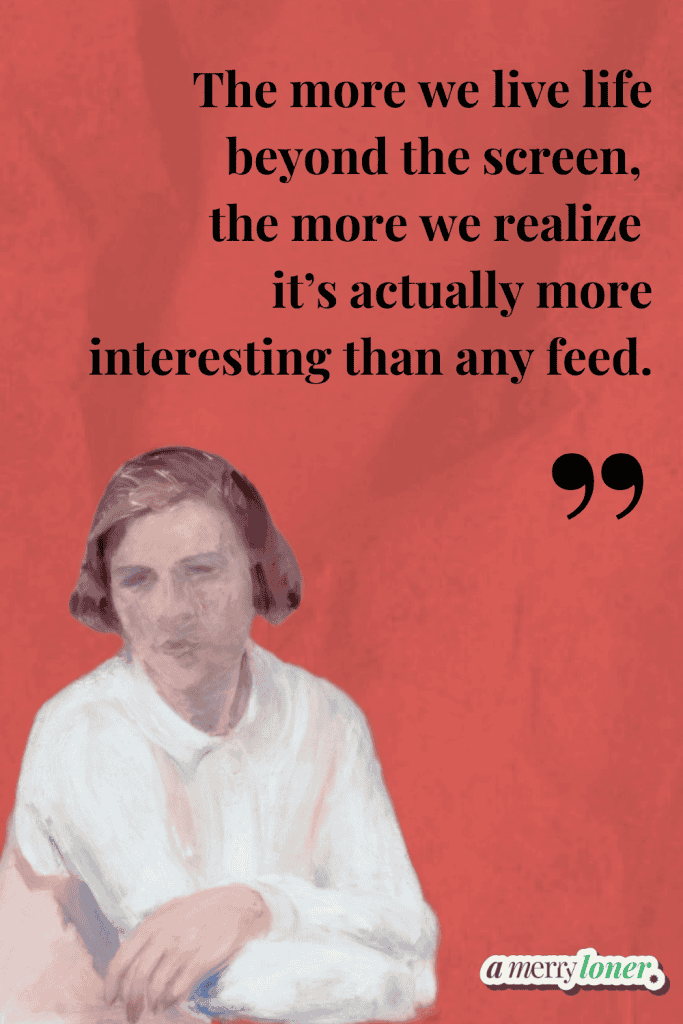
            Quote graphic on red background with impressionist-style painting of a woman in white blouse saying social media robs us of time

            Quick minute activities to do instead of scrolling Instagram

            Something that changed my life? Realizing I can still get value out of an activity even if I don’t do it for what I feel is a “worthwhile” amount of time. Doing yoga for 10 minutes is better than not at all. Going for a walk for 5 minutes is better than staying cooped up. 

            If you have less than 10 minutes? There’s still a lot of good you can do for your body and your mind: 

            Do a five-minute stretch. When I’m working from home and need a break between tasks, I used to “treat” myself with a few minutes on Instagram. Those few minutes usually ended up being longer than intended—and afterwards, I felt listless, burnt out, and mad at myself for wasting time. Now I pull up a 5-minute “at-your-desk stretch” on YouTube. Those five minutes feel like 15! At the end, I actually feel energized and ready to focus again—and happy with myself for making the right choice. 

            Look out the window. Not just a two-second quick break from your laptop. More like a long, rolling gaze. What do you see? Passers-by? Trees swaying a little in the breeze? Cute dogs walking by? Give yourself a few minutes to daydream. It’s like TV in your head.

            Drink a glass of water. Like the most important things in life, it may not be glamorous, but it’s good for you. Then again, you can make it glamorous. Take five minutes to slice a lemon or some mint leaves. Toss in a few frozen raspberries. (I always keep those in the freezer for smoothies and fancy-ing up my water.) It gives your body a refresh; it gives your hands something to do; and it looks beautiful. Because life should be beautiful.

            Bonsai tree against cloudy sky with text overlay about mindless activities instead of doomscrolling

            Mindless things to do instead of social media

            Like everyone else in the world, I also sometimes just want to zone out and not think. That’s normal; that’s fine. But if you find yourself dissociating on TikTok too often for too long, it might be time to kick that habit and replace it with something equally brainless but a little less addictive. 

            Play with kinetic sand or putty. You can even get a little Zen garden to rake. It’s strangely satisfying and gives your brain a moment to zone out with an actually relaxing activity—instead of aggressive doomscrolling which, according to a research review published in Applied Research in Quality of Life, is bad for our mental well-being and life satisfaction. Just saying. SOURCE: Harvard Health Publishing

            Color, doodle, or knit. All excellent options for zoning out without turning to social media. I’ve started doing this if I get stressed in the middle of the workday and need a few minutes to decompress. I put on some relaxing music (or even a guided meditation if I’m really stressing), grab a piece of paper, and let my brain be blissfully thoughtless.

            Bathroom scene with candles and table promoting tips for what to do instead of checking social media before bed

            Things to do instead of checking social media before going to bed

            I don’t think I need to cite a statistic to demonstrate how often people look at social media before going to bed. We’re all guilty of it. And we know it’s bad for us, sending our bodies into a state of heightened alertness which (unsurprisingly) wreaks havoc on our sleep, per Scientific American.

            Try this instead:  

            Stretch. A great way to start the day—and a great way to end it. Even if I’m super tired and come home later after a busy day, I can’t just crash into bed. Instead, I’ll open my laptop and pick a 10-minute evening wind-down stretch, which helps both my mind and my body decompress and get ready for a restful sleep. 

            Journal. Is there ever a bad time to journal? I don’t think so. Especially before bed when our minds are often running wild with the next day’s to-do list or a highlight reel of all the cringey stuff we said that day, journaling is a quick, easy, free way to let it all out and calm down for the night. 

            Read. I know people are into their e-readers, but in this case, a real book is best. In a study published by the journal Trials, one-third of participants said reading a book before bed improved their sleep. And I believe it. If I get into bed with a screen, I’ll probably stay up for 30+ minutes scrolling or watching. But if I crack open a book, I’ll be like an old man “resting my eyes” within 15 minutes.

            Embroidery supplies and scissors with text overlay about hobbies to replace social media

            Hobbies to replace social media you can do anywhere

            If you want to quit your social media habit and make it stick, then you need to do more than resist temptation—you need to find a new go-to activity for filling downtime. 

            Enter hobbies. It seems like nobody has them anymore, even though research says hobbies are tied to better mental health. (Nobody’s saying that about social media, are they?) 

            Here are few on-the-go hobbies you can keep your bag to do instead of social media: 

            Drawing. Keep a tiny notebook in your bag and pull it out the next time you’ve got a few minutes to kill and want to reach for the phone. (No excuses! Pocket notebooks are easy to find, and these days, they’re probably smaller than that giant iPhone you’re carrying, anyway.) 

            Learning a new language. I’ve abandoned DuoLingo because I’m trying to go completely screen-free, but I have an impressive 700+ day streak for quite a while. (I actually used DuoLingo to help me kick my social media habit.) And guess what? All those five- or 10-minute daily exercises added up! These days, I can confidently order a coffee, clumsily ask for directions, or even struggle through reading a children’s book in Polish. 

            Playing cards. Solitaire. Go Fish. War. You may need a little more time (and space) to whip out a card game, but if you’ve got a flat surface, it’s a great way to fill the time without giving into the doomscroll. 

            Knitting. Or crocheting. I used to do cross-stitch. Depending on how big your everyday bag is, these projects can be surprisingly easy to carry out and pull out when you’ve got a few minutes of downtime. They keep your hands busy—and are much better for your brain than mindless scrolling.

            Quote graphic on red background with impressionist-style painting of a woman in white blouse saying life beyond the screen is more interesting

            Conclusion: There’s so much life beyond social media

            Scrolling may seem like just a pesky habit, but it’s so much worse than that. Social media robs us of the most valuable thing in the world: time. 

            Time to spend with friends and family. Time to spend with ourselves. Time to learn new skills and discover new hobbies. Time to think. 

            Don’t you want to take that time back? 

            You don’t need to go cold turkey. There’s nothing wrong with enjoying checking out the fun goings-on online. But don’t let mindless scrolling become your default—not when there are so many great things to do instead of social media. 

            Things that leave you feeling refreshed rather than drained. Inspired instead of depressed. 

            If you’re looking for what to do instead of social media, just start small. Try one thing, and notice how it changes your mood, your focus, and your days. 

            The more we live life beyond the screen, the more we realize it’s actually more interesting than any feed.

            Next Steps:

            Pick one activity from this blog post and write in a Post-It. Stick that Post-It on your phone. The next time you get the urge to scroll, lock your phone screen, and try out your new analog activity instead. 

            Buy a book. Or rent one from the library. Keep it in your bag. When you want to reach for social media, reach for this book instead. Need reading inspiration? Check out my 2025 reading list.

            Find more ways to cut the digital from your life. Read How to Live a More Analog Life: 5 easy, cheap (or free) ideas.

            Use the image below to save this post to Pinterest so these tips are there when you need them.

            What To Do Instead of Social Media: Common FAQs

            What to do when bored instead of social media?

            Boredom actually isn’t a bad thing. The next time you’re feeling bored, instead of reaching for social media, let yourself sit with that boredom for a few minutes. Where does your mind go? If you need to let it out, try journaling or doodling—or just let the daydreaming run wild. When in doubt, move your body. Even a 10-minute walk can change your entire perspective.

            Instead of going on social media, what hobbies can I pick up so I never get bored?

            Hobbies are kind of like dating: You need to try a few and see what else is out there before you know what you like. So start experimenting! Keep a journal in your bag to draw or write in your free time. Explore classic novels to find your inner bookworm. Download a productive app to learn a new language, play chess, or try word puzzles. If one hobby doesn’t stick, no worries—try something else.

            What do people with no social media spend their time doing?

            Plenty! They read, write, draw, cook, play games, exercise… The list goes on and on! Most notably, people who don’t fill all their downtime with social media have usually mastered the skill of learning to do nothing. It’s not always easy at first, but the more you spend time in the real world, the less you’ll feel the pull to the digital. You can start with these 5 ways to live a more analog life.

            What can I do on the Internet instead of social media?

            Rather than scrolling mindlessly with whatever the latest algorithm decides to forcefeed you, try using the Internet intentionally. Read articles or blog posts. Watch documentaries. Take online courses. Listen to music—not just as background noise. The Internet literally contains all the knowledge of the universe. And it’s a lot easier to access the good stuff when you stop defaulting to your social media feed.

            With what can you replace social media scrolling?

            It depends what you’re into. If you’re a reader, start carrying a book everywhere you go. If that’s not your thing, invest in a good notebook for journaling, writing, or sketching. Or if you’re hooked on apps, try a more productive one, like DuoLingo for language learning or World Map Quiz for geography. An analog break is even better, like five minutes of stretching, walking, or looking out the window—anything offline to break the scroll and remind you there’s life beyond the feed.

            Discover how the merry loner lifestyle makes life more enjoyable:

            LONER MINDSET: fresh perspectives on learning to genuinely enjoy your own company

            BOOKS: reading lists for people who love being alone with a good story

            ANALOG LIVING: inspiration to step back from the screen and live a life offline

            SOLO TRAVEL: guides on where to go and how to enjoy it alone

            MINDFUL CONSUMPTION: vetted recommendations for a simpler, less wasteful life

            LONER Q&As: interviews from global voices on how to live a meaningful, enjoyable life
            Merry

            Merry is the blogger behind A Merry Loner, a full-time freelance writer, and a lifelong bookworm. Since kindergarten, it was her dream to become a novelist. (She likes to think she’s halfway there.) Born and raised in Rhode Island, where she earned a triple-major BA in writing, communication, and French from the University of Rhode Island, she moved to Toulouse, France after the pandemic to complete a master’s in creative writing at Univeristé Toulouse Jean — Jaurès. She now lives in Paris with husband.

            Feeling Lonely?

            I believe a happy life starts with learning to love your own company.

            Every week, I write a newsletter with notes on books, analog living, solo travel, and mindful consumption—the pillars of what I call the Loner Mindset.

            Because when you can be happy on your own, you can do anything.

              I respect you and your inbox. No SPAM. You can always unsubscribe if you change your mind.

            • How to Live a More Analog Life: 5 easy, cheap (or free) ideas

              How to Live a More Analog Life: 5 easy, cheap (or free) ideas

              Is the analog revolution here?

              Is going analog the new hipster obsession? That’s my prediction . You’ve heard of digital detoxing, dopamine fasting, and other go-screenless battle cries that ironically begin and see their heyday mostly on people’s screens. But one thing I can really get behind is going analog.

              Like many people, I stare at my screen all day long for work (and too often, for pleasure, too), so I’m making it a point this year to rid myself of as many unnecessary machines as possible and live life more in the slow lane.

              And I don’t just mean intelligent machines like your smartphone or whatever creepy smart device has recently memorized the layout of your living room—I’m talking basically anything that uses power.

              Arbitrary as it may be, this is my new goal: to ditch the digital for the old-school and the manual—and, just maybe, cling to my sanity in our overflowing world of kaleidoscopic distractions.

              The shortlist: 5 ways to live a more analog life

              1. Brew coffee without a machine—what to do instead

              2. Wake up to an alarm clock instead of your phone

              3. Read on paper: books, magazines, and newspapers + recommendations on where to start

              4. Cut unnecessary stimulation: run errands without listening to anything

              5. Use candlelight (no, really)

              What does analog living have to do with being a merry loner?

              It’s about reclaiming the freedom to take a step back. I value real life over virtual noise or performance—and I don’t want to give in to the pressure to be constantly plugged in.

              Sign up for A Merry Loner’s weekly newsletter, and I’ll share simple analog habits, screen-free activities, and non-judgmental reminders to slow down and enjoy life offline.

              You’ll also get notes about books, solo travel, and mindful consumption—the pillars of the Loner Mindset.

                I respect you and your inbox. No SPAM. You can always unsubscribe if you change your mind.

                1. Brew coffee without a machine

                The minimalist fighting for its life in your maximalist routine will thank you.

                Instead of beginning each morning by puncturing yet another Keurig cup or Nespresso pod, robotically pressing a button, and allowing the ungodly garbling sound of mechanized coffee-brewing to disturb your morning tranquility, how about a less audibly abrasive option?

                These days, my preference is a moka or a classic pour-over, but I used to use an Aeropress. If you want to get really retro and funky, you can even use a Chemex like my parents do. (She’s not a regular mom; she’s a cool mom.)

                There are a lot of reasons to go analog and brew your coffee without a machine:

                1. It takes up less room. Instead of an enormous, ugly, plastic appliance spoiling your otherwise very Pinterest-y kitchen counter situation, you could show off an elegant stainless steel moka (this is the one I have), a glass Chemex, or a porcelain coffee filter for dreamy pour-over coffees.

                2. It’s sexier. See above.

                3. It’s quieter. I know espresso and Keurig technology have come a long way in the last years, but still. I want sunrise salutation music in the morning or birdsong—not my Keurig straining to do its very best.

                4. It’s cheaper. Not only are analog coffee brewing methods a fraction of the price of their more mechanized counterparts, but they also don’t come with ongoing costs, i.e., no expensive pods to repurchase (and throw away) over and over again.

                5. It’s more sustainable. Again with the pods. Not only is buying coffee pods an unnecessary expense, but it’s also unnecessary trash. Sure, some places let you bring them in to recycle them (but how often do you actually do that?).

                Analog options for brewing coffee: 

                THE MOKA POT: My personal favorite. Elegant. Super low maintenance. And easy to brew. Plus, I love the way my all-stainless-steel moka pot looks on my stove.

                THE POUR-OVER: My second favorite method. This is where I turn when I want a longer, lighter coffee. You can simply pop a pour-over on top of any mug. But I like the elegant combination of a porcelain filter and a glass coffee pot. 

                THE AEROPRESS: This is how I brewed my coffee when I was 21 years old in my first apartment. It’s cheap; it’s effective; and it’s travel-friendly. Only con? You need to buy the right-sized filters.

                THE CHEMEX: Both my Millennial brother and my Boomer parents love to brew their coffee this way. IMHO, it’s like the pour-over method, but a little more complicated. Still, if you’re looking to make your daily coffee ritual coffee slow and soothing, this is a solid option.

                2. Wake up to an alarm clock instead of your phone

                This was my MO back in the day until the wreckage of a house fire turned my beloved alarm clock into a water-clogged mess. Honestly, that was over a decade ago, and I’m embarrassed to say that I haven’t bought a new one since. Instead, I’ve become even more reliant on my phone—and my mental health is paying the price.

                If I wake up in the middle of the night and want to check the time, not only do I have to hold a blaring blue light in front of my squinty, naked mole rat eyes, but I’m immediately assaulted by whatever emails or messages have accumulated while I sleep. (Considering I live in Paris and many of my friends, family, and colleagues are six hours behind me in the USA, the damage is usually severe.) Plus, that means I’m bombarded by notifications the very second I wake up to my alarm in the morning, which is a fabulous way to spike my blood pressure and cortisol levels before I even step out of bed.

                My husband and I agree: We need to get an alarm clock ASAP. I’m thinking about getting a fancy one so I can wake up to birds chirping and fall asleep to rainfall—or I might just get your very ’90s clock radio so I can wake up to “classic jams” and a radio announcer à la Groundhog Day.

                Another perk of switching to an alarm clock? There’s no need to keep my phone on my bedside table, so I can banish it to another room at bedtime and prevent doom-scrolling from taking hold of me.

                Pro tip: Not ready to convert to an analog alarm clock, but want to do something about the middle-of-the-night notifications? 

                Switch your phone to Airplane Mode before going to bed.

                I’ve recently started doing this, and it’s a total game-changer. Now at least when my phone alarm goes off in the morning, I’m not affronted with emails, text messages, and other notifications—and my morning stays peaceful. 

                3. Read on paper—books, magazines, and newspapers

                I’ve been getting back into analog reading lately. When I moved to France three years ago, I started spending a lot more time reading on the screen because I no longer had access to my English-language library. While I do like reading in French, there’s still so much that I want to read in English.

                Over the last few months, I’ve made a pointed effort to read more on paper—and it’s been bringing some serious calmness to my life.

                Like many people, I stare at my screen all day, every day for work. Unfortunately, many of my favorite leisure activities (reading and writing) are also very screen-heavy. To be a little gentler on my eyes (and my mind), I’m switching to paper:

                • I’m buying more books. Besides romantically strolling through local bookstores, I’m a huge fan of Awesome Books. They ship worldwide and sell both used and new copies.

                • I’m going to the library. Honestly, a big part of the reason I’ve re-fallen in love with libraries is that they’re one of the few places you can go in public for some peace and quiet. And they’re free.

                • I’m visiting newsstands. In my mind, I’m wearing a trench coat and a magnificent pair of leather gloves while doing it. Most importantly, I like to buy newspapers or magazines that I choose instead of just scrolling through whatever articles the algorithm has decided to force-feed me today.

                In the past, I used to buy books only very rarely. I thought it was a waste of money when I could just get what I needed at the library, but now I’m singing a different tune. What used to seem like a waste of money to me now feels like a way to hold onto my sanity in our digitally suffocating world.

                Plus, reading on paper has really helped me sleep better. I love reading before bed, but reading on an iPad or Kindle doesn’t send me into Zen mode the same way turning a page does. I even bought myself a clip-on book light for Christmas. I haven’t had one of these since I was a kid and let me tell you: It is thrilling.

                I know you probably already have books at home…

                But what bookworm doesn’t love new book recommendations? For the curious…

                This is what I’ve been reading in 2025. Memoirs. Novels. A Nobel Prize winnder. And some translated works. 

                These are bookshelf mainstays for the world is stressing me out—AKA, my favorite books for existential dread.

                These are the easy-read classic novels I always recommend to people who want to get into the classics. (I support you.)

                Need book recommendations? It’s your lucky day.

                I’ve compiled classic and contemporary book recommendations, themed round-ups, and book lists of what I’m reading, what I’ve read, and what’s next on my bookshelf.

                4. Run errands without listening to anything

                The next time you take your stupid little mental health walk or commute or run errands, try to do it without stimulation. That means no listening to podcasts, no audiobooks, not even music.

                If you’re not feeling enthused, take a moment to reflect: When was the last time you exercised or went grocery shopping or even just walked down the street without listening to something?

                It’s an overstatement to say we’re constantly stimulated, but our content saturation goes beyond the typical doom-scrolling and notifications. Just try to go to a public place (besides a library) where they’re not playing music at an unreasonable decibel. (I’ve yet to find one.) Or try to find someone sitting on the bus or walking down the street who’s not also talking on the phone or listening to music or scrolling.

                It’s harder than it seems, right? 

                The stimulation is everywhere—and it’s destroying us in new and exciting ways, like causing sleep problems, contributing to depression and anxiety, impairing learning and memory abilities, and even increasing risks of brain disease. [Source: National Library of Medicine and Stanford Lifestyle Medicine].

                I’m definitely guilty of overstimulating myself. Even when I’m just walking down the street, I’m usually also answering text messages, reading emails, or making yet another list I will probably soon forget about.

                So I’m trying to get better at catching myself: If I walk down the street and reach to pull my phone out of my bag, I force myself to put it away and go for an old-fashioned analog walk the way nature intended: without digital stimulation.

                Learn how to do things alone—without feeling lonely

                a comfortable, nonjudgmental email challenge that helps you own the power of being alone

                (See what’s inside.)

                  5. Use candlelight (no, really)

                  Yes, I know this sounds insane, but hear me out.

                  I’m not saying you have to go all Laura Ingalls Wilder and give up electricity, but you’ll be surprised how good it can feel to live by candlelight, if only for a few minutes out of the day. You can:

                  • luxuriate in a bath with half a dozen scented candles surrounding you like a Grecian goddess

                  • create a reading nook where you only read by the flickering flame

                  • enjoy dinner for one next to the heat of a candelabrum

                  Forgoing the bright (dare I say fluorescent) lights for a soft, candlelit glow is not only easier on the eyes, but it’s a simple (and cheap) way to romanticize your life, whether you’re striking a match for date night or settling in for a loner date with yourself.

                  There are literally billions of scented candles out there to choose from, but you don’t have to go luxury if you don’t want to. You can find affordable, basic candles at your local grocery store or even 7-Eleven.

                  What’s your style? Tea lights? Jar candles? Long candlestick holders that let you play Wuthering Heights and wander around the house in an elegant lace nightgown with only a small flame to guide you? You do you (no one else needs to know).

                  Conclusion: Living your analog lifestyle

                  What do you think, friends? Is the analog revolution here? I like to think so—at least, that’s what I tell myself whenever I open the news or read something even remotely involving the words “meme,” “cryptocurrency,” or “AI.”

                  In a world of bros, billionaires, and brats, I’m simply yearning for a little bit of romantic analog relaxation.

                  Next Steps:

                  Start small—pick one analog habit to adopt. Maybe that means getting a new coffee pot, switching to an analog alarm clock, or ordering a few books from your favorite bookshop. Need inspiration? Check out 5 Alternatives to Amazon for Books (and why I no longer buy books from Amazon).

                  Find more ways to cut the digital out of your life. If social media is stealing all of your attention and making you stressed, maybe it’s time to cut back a little. Here are 34 Ideas of What To Do Instead of Social Media for the next step you get the urge to scroll.

                  Practice getting comfortable with no stimulation. I know, it’s not easy. Many businesess are actively working to keep us addicted to technology. Get more comfortable spending time with just yourself—no digital stimulation—by signing up for A Merry Loner’s 7-Day Do Things Alone Challenge.

                  How to Live a More Analog Life: Common FAQs

                  How do you strike a balance between digital connectivity and unplugging from technology in your daily life?

                  I couldn’t give up technology cold turkey, even if I wanted to. I live in Paris, and my family and many friends are back in the USA. I’m also a full-time freelance writer and can’t possibly do my work without my laptop or the Internt.

                  But I take active steps to make sure my whole life isn’t on the screen. I read paper books—and I buy them from ethical bookshops instead of Amazon. I’m taking sewing lessons, and I try to fill my free time with activites other than social media.

                  To strike a balance between digital connectivity and unplugging from technology, try going screen-free one day per week, and build from there. Need ideas? Learn how to enjoy your own company without any external stimulation.

                  What is the digital-analog life balance?

                  It’s about finding a balance between the many digital device we touch every day and the analog world. And that balance looks different for everyone.

                  Maybe you can’t be without your smartwatch because you love using it to track your fitness and sleep—that’s fine. To balance it out, maybe switch to an analog alarm clock so your eyeballs don’t see a screen first thing in the morning and last thing at night. 

                  It will take some experimenting, but basically the digital-analog balance is about adding some analog back into our lives so they’re not overrun by the chaos of screens, notifications, and advertisements.

                  How does one live a full and engaged life today without the Internet?

                  It’s totally possible to live an engaged life without the Internet—or any external stimulation, for that matter. I believe living a full, happy life starts with learning to enjoy your own company. That might mean taking yourself out to dinner, going on a solo trip, or just enjoying an afternoon cozy at home. 

                  Not yet comfortable with solo travel or solo dinner dates? Sign up for A Merry Loner’s 7-Day Do Things Alone Challenge, and learn how to own the power of being alone.

                  Picture of Merry

                  Merry

                  Merry is the blogger behind A Merry Loner, a full-time freelance writer, and a lifelong bookworm. Since kindergarten, it was her dream to become a novelist. (She likes to think she’s headed in the right direction.) Born and raised in Rhode Island, where she earned a triple-major BA in writing, communication, and French from the University of Rhode Island, she moved to Toulouse, France after the pandemic to complete a master’s in creative writing at Univeristé Toulouse Jean — Jaurès. She now lives in Paris with husband.

                  Discover how the merry loner lifestyle makes life more enjoyable:

                  LONER MINDSET: fresh perspectives on learning to genuinely enjoy your own company

                  BOOKS: reading lists for people who love being alone with a good story

                  ANALOG LIVING: inspiration to step back from the screen and live a life offline

                  SOLO TRAVEL: guides on where to go and how to enjoy it alone

                  MINDFUL CONSUMPTION: vetted recommendations for a simpler, less wasteful life

                  LONER Q&As: interviews from global voices on how to live a meaningful, enjoyable life
                  Feeling Lonely?

                  I believe a happy life starts with learning to enjo your own company.

                  Every week, I write a newsletter with notes on books, analog living, solo travel, and mindful consumption—the pillars of what I call the Loner Mindset.

                  Because when you can be happy on your own, you can do anything.

                    I respect you and your inbox. No SPAM. You can always unsubscribe if you change your mind.

                  • 20 Journal Prompts for Anger | How Anger Writing Prompts Can Help You Work Through Your Feelings

                    20 Journal Prompts for Anger | How Anger Writing Prompts Can Help You Work Through Your Feelings

                    I can be quite a hothead sometimes. Call it passionate or strong-willed, and maybe it sounds a little bit better. But it’s still one of the main things I’m trying to work on in the realm of self-development. We all get angry sometimes, though. And suppressing those incensed feelings is certainly not the way to a happy mind and healthy relationships. 

                    While we can’t always whip out a notebook and start writing down all our emotions in the heat of the moment, journaling can be a really useful tool to turn to for help managing anger, resentment, frustration, and all the other dark-cloud, daggers-in-the-eyes feelings that sometimes rise to the surface. 

                    Whether you’re stewing in white-hot rage from something that happened earlier today or you’re still feeling the burn of what you pretend is a long-forgotten argument, anger writing prompts can help. 

                    Related Posts:

                    3 Benefits of Journaling for Anger Management

                    But first, why even consider turning to pen and paper when you’re feeling angry? Well, it obviously beats the other options: 

                    1. Banging your head against the wall
                    2. Breaking something
                    3. Yelling at someone
                    4. Screaming into the abyss
                    5. Burying the angry feelings deep down and pretending they don’t exist—only to be revealed years later in arduous (expensive) therapy

                    In comparison, taking a few minutes to respond to some anger journal prompts sure seems like the better choice, right? Here are a few benefits of journaling for anger management: 

                    1. It reduces stress

                    Journaling is an easy way to let out all your emotions without causing a dumpster fire. After all, no one’s going to read what you write, so you can release all the nasties without hurting someone else or burning bridges. 

                    This makes journaling a great, risk-free way to express your emotions. In turn, you’ll also reduce your stress load. According to James Pennebaker, Ph.D., psychologist and Professor Emeritus of Psychology at University of Texas at Austin, repressing emotions leads to stress. And nobody wants that—so get journaling. [Source: Duke Health]

                    2. It helps you identify your triggers

                    If you make journaling for anger management your go-to response for dealing with frustrating situations, overtime you can actually become better at managing your feelings. 

                    How? When you regularly write your feelings in a journal, you can begin to pinpoint the situations, people, etc. that trigger your anger. Then, you can develop tactics to help you keep your cool the next time you find yourself in a situation that makes you want to pull your hair out. [Source: Mental Health America]

                    3. It improves your emotional intelligence

                    Those angry feelings may be coming in hot—but that doesn’t always mean they’re easily identifiable. You know the feeling when you’re angry or frustrated about something … but you don’t really know why? 

                    Journaling can help. By taking the time to slow down, really process your thoughts, and write it all out, you can get a better understanding of your own strengths, weaknesses, and behaviors. And being fully aware of your emotions is the first step in learning how to better control them—so they don’t control you. [Source: University of St. Augustine for Health Sciences]

                    10 Journal Prompts for Anger

                    I know—when your blood is starting to boil, turning quietly to your journal isn’t usually the first instinct. So if find yourself staring at a blank page and silently fuming, whip out one of these anger journal prompts.

                    Don’t like the first one? No worries—just move on to the next. I’m all about the options.

                    Here are 10 journal prompts for anger that you can use any time, anywhere:

                    1. Reflect on a recent situation that made you angry.

                    • How did you handle the situation? 
                    • Why do you think you responded that way? 
                    • Could you have responded differently? 

                    2. Write a letter to someone who has caused you anger or hurt in the past.

                    • What did you say to them in the moment that you wish you hadn’t? 
                    • What did you NOT say to them in the moment that you wish you had? 
                    • What do you need (if anything) to move on from feelings of anger or hurt? 

                    3. Imagine yourself in a peaceful and serene place.

                    • Describe a scene that makes you feel calm and comfortable. 
                    • Why does it make you feel that way? 
                    • What can you do to recreate even a small part of that scene in your real life today?

                    4. Describe a healthy outlet or activity that helps you release anger.

                    • How do you feel after doing this activity? 
                    • Why do you think it helps you release your anger?
                    • Is it possible to do this activity more often? 

                    5. Reflect on a time when you successfully managed your anger. 

                    • What made you feel angry at the time? 
                    • How did you respond? Why do you think it worked? 
                    • Can you do this again the next time you feel angry?

                    6. Write a dialogue between your angry self and your rational self. 

                    • What does your angry self want to tell your rational self? 
                    • What does your angry self think your rational self doesn’t understand? 
                    • How can your rational self help your angry self?

                    7. Create a gratitude list of things or people that bring you joy and happiness.

                    • Do these things and/or people help relax you? 
                    • Can you return to this list every time you get angry? 
                    • How can you remember this list in times of anger?

                    8. Reflect on the long-term consequences of holding onto anger. 

                    • What does being angry do for you? 
                    • Is there something you feel angry about that you want to let go?
                    • What will holding onto a grudge do to you in the long term?

                    9. Write a fictional story that symbolizes your anger. 

                    • Who are the characters? 
                    • What is their struggle? 
                    • Do they resolve their problems? Can they? 

                    10. Imagine yourself having a compassionate conversation with someone who causes you stress, anger, or hurt.

                    • Do they know they’re making you feel this way? 
                    • Do they intend to make you feel this way? 
                    • How are you making them feel? 

                    5 Journal Prompts for Resentment

                    Oh, resentment. She’s a nasty beast. Not to get all Merriam-Webster on you, but let’s first go over exactly what the word means. This dictionary defines resentment as: “a feeling of indignant displeasure because of something regarded as a wrong, insult, or other injury.”

                    Ouch. Nobody likes to feel wronged or insulted. (And when we feel that way, it often brings out the very worst in ourselves.)

                    Let’s try to put a lid on it. Or rather, better understand it with these five journal prompts for resentment:

                    1. Reflect on a specific situation or person that you feel resentful towards.

                    • Why do you feel resentful towards them? 
                    • How long have you been feeling this resent? 
                    • What do you need to let it go?

                    2. Identify three positive qualities or lessons you can draw from the situation or person that caused resentment. 

                    • Did you learn anything from them? 
                    • How has this situation helped you grow? 
                    • If you could get a do-over of the situation, what would you do differently, if anything? 

                    3. Write a letter to the person you resent.

                    • Do they know how you feel? 
                    • Do you want them to know how you feel? 
                    • When will you see them again? 

                    4. Write a letter to yourself, forgiving yourself for holding onto resentment. 

                    • Why are you holding onto resentment? 
                    • Are you ready to let go? 
                    • What do you need to let go? 

                    5. Imagine a scenario where you have completely let go of resentment.

                    • How does this scenario make you feel? 
                    • Do you want to realize this scenario? 
                    • If so, how can you make it happen?

                    5 Journal Prompts for Frustration

                    Have you ever been so frustrated that you’ve thrown a wooden spoon across the room? No? Just me. Okay, then. (Maybe that makes me sound like a total crazy person, but I: 1) was really angry; 2) wanted to release my anger with something that made a clatter; 3) didn’t want to break and/or hurt anything and/or anyone (or clean up a mess.))

                    I digress. Seems like journaling might have been the better option. So next time, I’m going to turn to one of these journal prompts for frustration:

                    1. Describe a recent situation that caused you frustration.

                    • Who was involved in the situation?
                    • When did the frustration start? 
                    • Did you share your feelings in the moment? Why or why not? 

                    2. Identify one aspect of the frustrating situation that you had control over.

                    • Did you try to change that one aspect? 
                    • Why or why not? 
                    • How do you feel about the way you handled the situation?

                    3. Imagine yourself finding a resolution or a positive outcome to the frustrating situation.

                    • What would you say or do? To whom? 
                    • Is there still time for you to say what you want to that person? 
                    • If not, is this something you can remember and apply for next time?

                    4. Reflect on a time when you successfully overcame a frustrating situation or obstacle.

                    • What made you feel frustrated? 
                    • How did you react? 
                    • What effect did your actions have?

                    5. Write a letter to yourself, acknowledging and validating your feelings of frustration. 

                    • Why do you still feel frustrated? 
                    • Are you ready to let go?
                    • What do you need to move on from your feelings of frustration?

                    How to Choose a Journal Prompt for Anger

                    There’s no need to overcomplicate journaling—and I’m not going to try to. But not every journal prompt is the right fit for what you’re feeling at the moment, so it does help to narrow down the search a bit before diving into writing. 

                    As you look for a journal prompt for anger, ask yourself:

                    1. What am I angry about right now?

                    Are you thinking about a specific situation? Or are you reflecting on your feelings or anger in general? 

                    If you’re seeing red because of something your unappreciative boss just said, you might not have time for a long journaling session right in the moment. Instead, try whipping out your phone and typing a few lines in your Notes app to help yourself calm down.

                    But if you’re stewing over reflecting on years of pent up feelings, then it may be a good idea to wait until you have at least 20 minutes to open up to a fresh page and try to release some of that angst.

                    2. What do I want to journal about?

                    Do you need to just word-vomit a whole bunch of rage? Or do you want to spend some time analyzing your feelings and finding strategies to work on your anger management and conflict resolution? 

                    Depending on what feels you’re feeling, there are a couple of different styles of anger writing prompts you can try out, such as:

                    Open-Ended Journal Prompts for Anger

                    These prompts lend themselves to more of a free-form style. They’re a good fit when you have the time to really just let your thoughts run wild for pages and pages. (Basically, these are the prompts to turn to when you want to vent your feelings but your mom or best friend isn’t picking up.)

                    Try this: Write about something in your life that consistently makes you angry. What are your immediate thoughts about this issue? Why does it make you angry?

                    Reflective Anger Writing Prompts

                    Rather than simply doing a brain-dump of all your angry feelings, these anger writing prompts are designed to help you focus more on introspection and self-analysis. In other words, be prepared to face the looking glass and take some responsibility for your actions. These are not the journal prompts for you if you’re still in the phase of having a big, old pity party for yourself (which we all need sometimes).

                    Try this: Think about the patterns in your anger responses. How do you typically cope with anger? Why do you think you behave this way? What is good or bad about your reactions?

                    Problem-Solving Anger Journal Prompts

                    If your blood is boiling and you feel like that little red character in Inside Out, perhaps try one of the open-ended journal prompts above before turning to this section.

                    Problem-solving anger journal prompts are best used when you’re a little past the white-hot anger stage and are ready to get constructive. This is where to turn when you need a sounding board to help yourself come up with solutions to better manage your anger.

                    Try this: Think of a situation (or relationship) that frequently triggers your anger. Then, brainstorm different ways you can respond to create a more positive outcome. Finally, think of what you can do proactively to prevent yourself from being in this situation to begin with.

                    Journaling Prompts for Anger—with Gratitude

                    Sometimes, you just need to be that (slightly annoying) person who is always positive no matter what the situation. Basically, you need to fake being positive until you make it.

                    While I definitely don’t advocate taking this approach all the time (after all, suppressing anger is its own problem in and of itself), sometimes forcing a little bit of positivity is all it takes to change your perspective and genuinely turn your attitude around.

                    And don’t just take it from me. One study from Stanford University indicated that faking a smile can, in some cases, actually make you feel better—for real. [Source: Nature Human Behavior]

                    Try this: Start by writing down what’s making you angry. Then, force yourself to write at least three things that aren’t SO bad about the situation. Add three things you can do to improve the situation. Finish with three things you’re grateful for—whether they’re relevant to the situation or not.

                    3. How much time do I have? 

                    Do you just have 10 minutes to quickly release some pent-up tension? Or do you have time for a long writing session where you can really pour your heart out? 

                    Personally, I think opened-ended, free-form journal prompts for anger are the best option when you’re short on time (like if you’re at work or at a party). For starters, you don’t have to focus on adhering to a specific theme. Instead, you can just quickly get your thoughts down on paper (or in your phone) to help you cool down before you have to get back to reality.

                    Pro tip: Don’t stop there! Close the loop on your venting by returning to this quick journal entry later for deeper reflection.

                    When you do have time for more careful reflection, that’s when I think problem-solving journal prompts for anger come in handy. Make a cup of tea (these are some tea recommendations for people who don’t drink tea but want to start). Put on your favorite angsty music. And get prepared to get all meta about your feelings.

                    3 Tips for Effective Anger Journaling

                    Of course, sometimes you don’t even need a prompt for anger journaling. You can just open a notebook or a Word document or a new page in your Notes app and let those sparks fly. 

                    And I’m not saying this style of anger journaling isn’t worthwhile. (It certainly feels pretty damn good, sometimes.) But if you want to get a little more out of your journaling session than just a brain dump and an explosion of bottled-up feelings, here are a few tips you can try to make your journaling practice more effective:

                    1. Incorporate mindfulness techniques

                    Before you start journaling all willy-nilly, take a second to ask yourself the above questions:

                    • What am I angry about right now? What do I want to journal about? How much time do I have? Pick a prompt that corresponds with what you’re feeling right now.
                    • Then, chill for a second. Try some mindful breathing. And if you think that sounds like a complete waste of time, consider this: Studies show that breathwork can actually be an effective strategy for reducing stress and improving mental health. [Source: Scientific Reports]
                    • Finally, when it’s time to start writing, go easy on the self-judgment. Seriously. It’s all too easy for us to be our own worst critics, even about our own thoughts and feelings. But journaling is your no-judgment zone. Just let it all out, judgment-free.

                    You can reread your journal entry immediately after writing, in a few hours, the next day, a week later, a month later … you get the idea. Or you can never reread it. Maybe you want to crumple it up and throw it away or simply leave it forgotten in the pages of an old notebook.

                    Personally, I love rereading my old journal entries. You know those cleaning sessions every year or so when you turn your whole home upside down and find yourself sitting in a mess getting nostalgic about stuff you found in the back of your junk drawer? Yeah, that’s usually when I end up reading my old journal entries. It’s a real blast from the past. I love seeing what younger Merry was up to and how she’s changed. Plus, it’s a great reminder that most of the things we stress, fret, and worry about eventually pass with time. But that’s a topic for another day …

                    2. Start doing it regularly

                    I know, I know. Another habit to add to your list of things to do every day. Right up there with meditating and exercising and reading and practicing gratitude and all that self-improvement stuff we tell ourselves we need to do to become less stressed but which just ends up making us more stressed.

                    Sigh.

                    Don’t let journaling become something stressful. You don’t have to do it EVERY single day, nor does every entry have to be a huge novella of all the feels. Rather, just a few quick lines most days out of the week counts as journaling.

                    The key is to make it a regular practice—even if that doesn’t mean every day. Because making writing a regular part of your routine can, in the long term, help you better cope with stress. (And don’t we all need more of that?) [Source: PubMed Central]

                    3. Look for patterns in your journaling

                    As you regularly respond to different journal prompts for anger, try to stop yourself every now and then and go back over old entries to look for recurring patterns.

                    For example, see if you can identify:

                    • What triggers commonly make you angry
                    • How you normally respond to these triggers
                    • What relationships in your life are sources of anger
                    • How these relationships have evolved over time
                    • What strategies help you manage your anger
                    • What strategies don’t help you manage your anger

                    4. Feel free to stray from the prompt

                    Spoiler: There are no journaling police. At least not any that I know. We’re not living in a 1984 dystopia yet. (Didn’t get that reference? No sweat—but it’s not too late to start flexing your classic literature muscles. Start by catching up on this list of the easiest classic novels to read.) (1984 is one of them.))

                    Anyway, what I mean is, don’t worry if you end up straying from the original prompt. After all, these journaling prompts for anger are mostly there to help you get going. In the end, you may find yourself writing about something totally different—and that’s okay!

                    Basically, journal prompts for anger are helpful to 1) get you started or 2) help guide you for a more specific analysis, if that’s what you’re into.

                    No pressure.

                    5. Get insight from a professional

                    Clearly, I am no health professional. I’m just talking about journaling, dude.

                    And while journaling may have many reported benefits for mental health, it is in no way a substitute for professional treatment or guidance.

                    So if you feel you need more help than a quick journaling session, please do get it—from the pros.

                    Understanding Anger and Its Impacts

                    Being angry is annoying. (I don’t have to tell you that.) But beyond just being a less-than-pleasant part of your day, anger is bad for you, your health, and your relationships. (After all, no one wants to be around a sourpuss all day.)

                    So if you need some more motivation to cool it with a few journal prompts for anger, just take a lot at theses statistic about the consequences of anger:

                    How Suppressed Anger Affects Your Health

                    Not a big shock, but here it is in black and white: Suppressed anger has been linked to depression. [Source: PubMed Central]

                    For more bad news, consider this: Multiple studies show that anger can determine diseases, like coronary disease, bulimia nervosa, diabetes, etc., and even be the cause of car accidents. Yikes! [Source: PubMedCentral]

                    So, yeah. I think it’s time to stop ignoring those journal prompts for anger and get writing.

                    Anger Writing Prompts: One Healthy Outlet for Expressing and Managing Anger

                    Of course, starting a journaling practice won’t just magically solve all your problems. (Oh, if only it were that easy!)

                    But it’s no exaggeration that turning to journal prompts for anger can go a long way to help you:

                    • Release your feelings to avoid anger suppression (and its scary potential consequences)
                    • Better understand your feelings
                    • Identify your triggers
                    • Come up with solutions to better manage your anger
                    • De-stress
                    • Remember to be grateful for the many things that DON’T make you angry
                    • Improve the way you communicate when you are angry
                    • Help you track your progress in becoming a better communicator, partner, friend, and personal, overall

                    One step (or page) at a time, eh?

                    My Experience with Journaling

                    I’ve been keeping a journal since I was in middle school. (I go through phases of writing every day and then practically not at all.) But even though it’s always something I advocate for and remind myself to do, I don’t write in my journal every day. 

                    (After all, there are so many good daily habits I want to pick up …  But there’s only so much time in the day!)

                    But you know what I find in looking back on my old entries? When life is good, I journal less.

                    Of course, this means that when I reread my journal, I often think, “Wow. I’m super depressed and my life sucks.” I have to remind myself that this isn’t true, that rather, my journal is just not a good representation of my daily life. This is because it’s usually in the bad moments that I turn to my journal for a good rant. And you know what? Nine out of 10 times, it works!

                    After burning through some journal prompts for anger, my attitude usually does a 180. I calm down, get some clarity, and walk away feeling much more optimistic and energized.

                    That’s one reason why I’m trying (again) to become more regular about journaling. But I don’t want to put pressure on myself and stress my perfectionist self out. That would just be coming full circle …

                    Have you tried any of these journal prompts for anger yet? Do you think you’ll get into a regular journaling practice soon?

                    Before You Go … 

                    Journaling is a great way to de-stress and take a break from our way-too-busy days.

                    Another way I like to chill out is simply pausing with a book for at least 20 minutes. Besides, you know, enjoying the book I’m reading, I welcome the pause from what feels like an always-stuffed schedule of always-urgent tasks.

                    Not feeling in a journaling mood? If you want to read instead and need some book inspiration, please read my article on the best easy-to-read classic novels.

                    Recommended Reading: