Are you ever daunted by the number of things you want to do? Besides the banalities of daily responsibilities (e.g., schedule doctor’s appointment; clean bathtub; hang up picture frames), my notebooks, Notes app, and many, many emails to myself are replete with reminders of even more things I want to do in the future.
Emphasis on the word “want.” These are not work responsibilities or household chores or personal admin tasks that seem to grow back in triplets for every one I accomplish. No, these are the things I actually want to do—goals, dreams, challenges, quests, whatever you want to call them.
Too often, these ventures get pushed to the side, neglected because we feel we don’t have enough time to dedicate to them. Even more often, I find we neglect these ventures because we think we don’t have the right person to do them with—the right set of friends, the perfect partner, whatever.
But if there’s something you want to do (or even just try out for the first time to see what you think), you really don’t need to waste time seeking out whom you might think is the requisite companion. You can just go ahead and do it, all on your lonesome. Because that lonesome can end up becoming your lifeline of wholesome in society’s chaotic maelstrom.
This year, I’m not waiting. I’m prioritizing the new things I want to do and I’m going out there and doing them—by myself. This is what’s in the calendar:
More inspiration on how to live an independent life you love?
Yes, please. Sign up for A Merry Loner’s newsletter to get the latest in your inbox.
1. Join a book club
I know, like I need more books to add to my unachievable-y long list of books to read. But I think going to a book club regularly feels retro and charming—just the kind of old-school, off-line activity that I’ve been looking for lately to make my life more analog.
I found two groups in Paris that I want to check out: a French feminist book club and a 20s-and-30s English book club. I like mixing up my reading between English and French, so I think I’m going to try both—will report back if there are any good reads.
There’s a pottery studio directly across the street from my apartment, and I believe it’s God’s intent to lead me there.
My kitchen cupboard’s full of mismatched, flea market finds, and I’d love to add some of my own creations to the mix, however wonky such first creations may be.
Plus, I love that this is a tactile, get-your-hands-dirty hobby. Considering my work and the majority of my hobbies involve me staring at screens (or at least at the written word), a little manual manipulation should do me a world of good.
3. Start volunteering once a month
Yeah, once a month isn’t a very lofty goal, but I’m trying to be realistic. Especially since (I’m sorry to say) it’s been years since volunteering was a part of my regular routine, it’ll be a bit of an adjustment to add it back into my schedule.
I’ve been checking out some options of what I can do in Paris, and I’m thinking of joining this community where you go and spend time with the elderly, particularly isolated members of the community who may not have anyone. Or, as the DeepL translation of the organization’s website says: “combat the isolation and loneliness of the elderly, especially the most disadvantaged, and enable them to regain a taste for life.”
My mom worked at a nursing home when I was growing up, and I would often go there to spend time with the residents in the recreation room, just chatting or playing games with them. It’s small, but it really can make a big difference for a lot of people.
Plus, joining an organization like this is definitely further outside of my comfort zone than going to a book club or a pottery class—and that’s kind of the point of this whole do things alone exercise, right?
Do you get nervous trying new things alone?
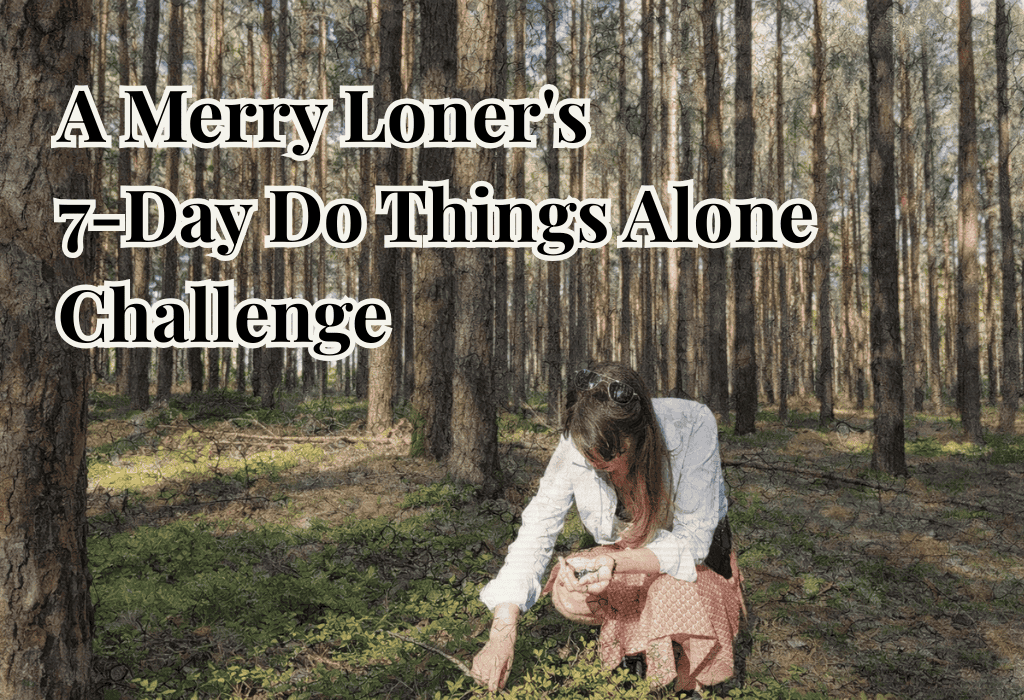
You can change that. Sign up for A Merry Loner’s 7-Day Do Things Alone Challenge. You’ll get:
A daily bite-sized challenge to help you experiment with doing things alone
A judgment-free zone to share all your feels about how the day’s activity went
A daily journal prompt to help you process and learn from what you did that day
4. Go to a concert
Last year, like millions of other Swiftian enthusiasts, I lived out my dream of going to The Eras Tour.
I spent an embarrassing amount of money on a ticket, crashed at a friend’s house in Warsaw, and grooved the night away. Separately, I was a bit dismayed by the lack of singing and dancing at the concert. At least considering the people next to me, I was one of the few not silently and dispassionately watching the show through the screen of my phone. But that’s another story.
I had a blast going to the Taylor Swift concert by myself, and I’m ready to party solo at another concert this year. This time, I’ll be heading to Barry Manilow’s The Last Concert in Providence. (Yes, I love these retro jams. And no, I have no shame.)
5. Complete a yoga teacher training course
This has been on my daydreaming list for some time, and I really want to make it happen sooner rather than later.
I’ve been practicing yoga since I was in high school (Spoiler: I just turned 28), but in the last 18-ish months, I’ve become really dedicated to practicing almost daily. It feels bloody great. But I want to learn more. I want to learn the deeper technicalities of proper form and mindset. Plus, going away for 2+ weeks to do nothing but practice and study yoga sounds like an absolute dream.
I’ve got my eye on a few retreats I’m considering, but haven’t done much research yet. Any insight or recommendations would be greatly appreciated.
Don’t put it off. Do what you want now—even if it means doing it alone.
If you don’t really love trying new things on your own, you’re not an outlier. Actually, Americans in their 20s miss out on a collective 26 experiences a year because they’re afraid of doing things alone. For 30-somethings, that number is more like 34 missed experiences per year.
I find that terribly sad. There’s a lot I want to do in my life, and if I can’t find someone to go to a concert or a pottery studio with, then I’m going to go by myself.
You only live once. Don’t spend your time waiting for other people to show up for you when you’ve been there for yourself all along.
Is going analog the new hipster obsession? That’s my prediction . You’ve heard of digital detoxing, dopamine fasting, and other go-screenless battle cries that ironically begin and see their heyday mostly on people’s screens. But one thing I can really get behind is going analog.
Like many people, I stare at my screen all day long for work (and too often, for pleasure, too), so I’m making it a point this year to rid myself of as many unnecessary machines as possible and live life more in the slow lane.
And I don’t just mean intelligent machines like your smartphone or whatever creepy smart device has recently memorized the layout of your living room—I’m talking basically anything that uses power.
Arbitrary as it may be, this is my new goal: to ditch the digital for the old-school and the manual—and, just maybe, cling to my sanity in our overflowing world of kaleidoscopic distractions.
The minimalist fighting for its life in your maximalist routine will thank you.
Instead of beginning each morning by puncturing yet another Keurig cup or Nespresso pod, robotically pressing a button, and allowing the ungodly garbling sound of mechanized coffee-brewing to disturb your morning tranquility, how about a less audibly abrasive option?
These days, my preference is a moka or a classic pour-over, but I used to use an Aeropress. If you want to get really retro and funky, you can even use a Chemex like my parents do. (She’s not a regular mom; she’s a cool mom.)
There are a lot of reasons to go analog and brew your coffee without a machine:
It takes up less room. Instead of an enormous, ugly, plastic appliance spoiling your otherwise very Pinterest-y kitchen counter situation, you could show off an elegant stainless steel moka (this is the one I have), a glass Chemex, or a porcelain coffee filter for dreamy pour-over coffees.
It’s sexier. See above.
It’s quieter. I know espresso and Keurig technology have come a long way in the last years, but still. I want sunrise salutation music in the morning or birdsong—not my Keurig straining to do its very best.
It’s cheaper. Not only are analog coffee brewing methods a fraction of the price of their more mechanized counterparts, but they also don’t come with ongoing costs, i.e., no expensive pods to repurchase (and throw away) over and over again.
It’s more sustainable. Again with the pods. Not only is buying coffee pods an unnecessary expense, but it’s also unnecessary trash. Sure, some places let you bring them in to recycle them (but how often do you actually do that?).
Analog options for brewing coffee:
THE MOKA POT: My personal favorite. Elegant. Super low maintenance. And easy to brew. Plus, I love the way my all-stainless-steel moka pot looks on my stove.
THE POUR-OVER: My second favorite method. This is where I turn when I want a longer, lighter coffee. You can simply pop a pour-over on top of any mug. But I like the elegant combination of a porcelain filter and a glass coffee pot.
THE AEROPRESS: This is how I brewed my coffee when I was 21 years old in my first apartment. It’s cheap; it’s effective; and it’s travel-friendly. Only con? You need to buy the right-sized filters.
THE CHEMEX: Both my Millennial brother and my Boomer parents love to brew their coffee this way. IMHO, it’s like the pour-over method, but a little more complicated. Still, if you’re looking to make your daily coffee ritual coffee slow and soothing, this is a solid option.
2. Wake up to an alarm clock instead of your phone
This was my MO back in the day until the wreckage of a house fire turned my beloved alarm clock into a water-clogged mess. Honestly, that was over a decade ago, and I’m embarrassed to say that I haven’t bought a new one since. Instead, I’ve become even more reliant on my phone—and my mental health is paying the price.
If I wake up in the middle of the night and want to check the time, not only do I have to hold a blaring blue light in front of my squinty, naked mole rat eyes, but I’m immediately assaulted by whatever emails or messages have accumulated while I sleep. (Considering I live in Paris and many of my friends, family, and colleagues are six hours behind me in the USA, the damage is usually severe.) Plus, that means I’m bombarded by notifications the very second I wake up to my alarm in the morning, which is a fabulous way to spike my blood pressure and cortisol levels before I even step out of bed.
My husband and I agree: We need to get an alarm clock ASAP. I’m thinking about getting a fancy one so I can wake up to birds chirping and fall asleep to rainfall—or I might just get your very ’90s clock radio so I can wake up to “classic jams” and a radio announcer à la Groundhog Day.
Another perk of switching to an alarm clock? There’s no need to keep my phone on my bedside table, so I can banish it to another room at bedtime and prevent doom-scrolling from taking hold of me.
Pro tip: Not ready to convert to an analog alarm clock, but want to do something about the middle-of-the-night notifications?
Switch your phone to Airplane Mode before going to bed.
I’ve recently started doing this, and it’s a total game-changer. Now at least when my phone alarm goes off in the morning, I’m not affronted with emails, text messages, and other notifications—and my morning stays peaceful.
3. Read on paper—books, magazines, and newspapers
I’ve been getting back into analog reading lately. When I moved to France three years ago, I started spending a lot more time reading on the screen because I no longer had access to my English-language library. While I do like reading in French, there’s still so much that I want to read in English.
Over the last few months, I’ve made a pointed effort to read more on paper—and it’s been bringing some serious calmness to my life.
Like many people, I stare at my screen all day, every day for work. Unfortunately, many of my favorite leisure activities (reading and writing) are also very screen-heavy. To be a little gentler on my eyes (and my mind), I’m switching to paper:
I’m buying more books. Besides romantically strolling through local bookstores, I’m a huge fan of Awesome Books. They ship worldwide and sell both used and new copies.
I’m going to the library. Honestly, a big part of the reason I’ve re-fallen in love with libraries is that they’re one of the few places you can go in public for some peace and quiet. And they’re free.
I’m visiting newsstands. In my mind, I’m wearing a trench coat and a magnificent pair of leather gloves while doing it. Most importantly, I like to buy newspapers or magazines that I choose instead of just scrolling through whatever articles the algorithm has decided to force-feed me today.
In the past, I used to buy books only very rarely. I thought it was a waste of money when I could just get what I needed at the library, but now I’m singing a different tune. What used to seem like a waste of money to me now feels like a way to hold onto my sanity in our digitally suffocating world.
Plus, reading on paper has really helped me sleep better. I love reading before bed, but reading on an iPad or Kindle doesn’t send me into Zen mode the same way turning a page does. I even bought myself a clip-on book light for Christmas. I haven’t had one of these since I was a kid and let me tell you: It is thrilling.
I know you probably already have books at home…
But what bookworm doesn’t love new book recommendations? For the curious…
I've compiled classic and contemporary book recommendations, themed round-ups, and book lists of what I'm reading, what I've read, and what's next on my bookshelf.
The next time you take your stupid little mental health walk or commute or run errands, try to do it without stimulation. That means no listening to podcasts, no audiobooks, not even music.
If you’re not feeling enthused, take a moment to reflect: When was the last time you exercised or went grocery shopping or even just walked down the street without listening to something?
It’s an overstatement to say we’re constantly stimulated, but our content saturation goes beyond the typical doom-scrolling and notifications. Just try to go to a public place (besides a library) where they’re not playing music at an unreasonable decibel. (I’ve yet to find one.) Or try to find someone sitting on the bus or walking down the street who’s not also talking on the phone or listening to music or scrolling.
It’s harder than it seems, right?
The stimulation is everywhere—and it’s destroying us in new and exciting ways, like causing sleep problems, contributing to depression and anxiety, impairing learning and memory abilities, and even increasing risks of brain disease. [Source: National Library of Medicine and Stanford Lifestyle Medicine].
I’m definitely guilty of overstimulating myself. Even when I’m just walking down the street, I’m usually also answering text messages, reading emails, or making yet another list I will probably soon forget about.
So I’m trying to get better at catching myself: If I walk down the street and reach to pull my phone out of my bag, I force myself to put it away and go for an old-fashioned analog walk the way nature intended: without digital stimulation.
Learn how to do things alone—without feeling lonely
a comfortable, nonjudgmental email challenge that helps you own the power of being alone
I’m not saying you have to go all Laura Ingalls Wilder and give up electricity, but you’ll be surprised how good it can feel to live by candlelight, if only for a few minutes out of the day. You can:
luxuriate in a bath with half a dozen scented candles surrounding you like a Grecian goddess
create a reading nook where you only read by the flickering flame
enjoy dinner for one next to the heat of a candelabrum
Forgoing the bright (dare I say fluorescent) lights for a soft, candlelit glow is not only easier on the eyes, but it’s a simple (and cheap) way to romanticize your life, whether you’re striking a match for date night or settling in for a loner date with yourself.
There are literally billions of scented candles out there to choose from, but you don’t have to go luxury if you don’t want to. You can find affordable, basic candles at your local grocery store or even 7-Eleven.
What’s your style? Tea lights? Jar candles? Long candlestick holders that let you play Wuthering Heights and wander around the house in an elegant lace nightgown with only a small flame to guide you? You do you (no one else needs to know).
Conclusion: Living your analog lifestyle
What do you think, friends? Is the analog revolution here? I like to think so—at least, that’s what I tell myself whenever I open the news or read something even remotely involving the words “meme,” “cryptocurrency,” or “AI.”
In a world of bros, billionaires, and brats, I’m simply yearning for a little bit of romantic analog relaxation.
Find more ways to cut the digital out of your life. If social media is stealing all of your attention and making you stressed, maybe it’s time to cut back a little. Here are 34 Ideas of What To Do Instead of Social Media for the next step you get the urge to scroll.
Practice getting comfortable with no stimulation. I know, it’s not easy. Many businesess are actively working to keep us addicted to technology. Get more comfortable spending time with just yourself—no digital stimulation—by signing up for A Merry Loner’s 7-Day Do Things Alone Challenge.
How to Live a More Analog Life: Common FAQs
How do you strike a balance between digital connectivity and unplugging from technology in your daily life?
I couldn’t give up technology cold turkey, even if I wanted to. I live in Paris, and my family and many friends are back in the USA. I’m also a full-time freelance writer and can’t possibly do my work without my laptop or the Internt.
It’s about finding a balance between the many digital device we touch every day and the analog world. And that balance looks different for everyone.
Maybe you can’t be without your smartwatch because you love using it to track your fitness and sleep—that’s fine. To balance it out, maybe switch to an analog alarm clock so your eyeballs don’t see a screen first thing in the morning and last thing at night.
It will take some experimenting, but basically the digital-analog balance is about adding some analog back into our lives so they’re not overrun by the chaos of screens, notifications, and advertisements.
How does one live a full and engaged life today without the Internet?
It’s totally possible to live an engaged life without the Internet—or any external stimulation, for that matter. I believe living a full, happy life starts with learning to enjoy your own company. That might mean taking yourself out to dinner, going on a solo trip, or just enjoying an afternoon cozy at home.
Merry is the blogger behind A Merry Loner, a full-time freelance writer, and a lifelong bookworm. Since kindergarten, it was her dream to become a novelist. (She likes to think she's headed in the right direction.) Born and raised in Rhode Island, where she earned a triple-major BA in writing, communication, and French from the University of Rhode Island, she moved to Toulouse, France after the pandemic to complete a master's in creative writing at Univeristé Toulouse Jean — Jaurès. She now lives in Paris with husband.
Discover how the merry loner lifestyle makes life more enjoyable:
LONER MINDSET: fresh perspectives on learning to genuinely enjoy your own company
BOOKS: reading lists for people who love being alone with a good story
ANALOG LIVING: inspiration to step back from the screen and live a life offline
SOLO TRAVEL: guides on where to go and how to enjoy it alone
MINDFUL CONSUMPTION: vetted recommendations for a simpler, less wasteful life
LONER Q&As: interviews from global voices on how to live a meaningful, enjoyable life
My 2024 books-read tally isn’t all that impressive, though I like to tell myself that that’s because I also spend a lot of time reading magazines and articles that don’t make their way into my precious GoodReads tracker. (Plus, I’ll unnecessarily point out that one of the books I read in 2024 was almost 500 words, so surely that’s got to count for something?)
Then again, reading isn’t a numbers game. It’s for the art, the entertainment, the culture, the knowledge, and—above all—the pleasure.
Out of the 17 books I shelved this year (from fiction to philosophy to history), these are my top five:
Yes, I am super behind the times. I know everyone already read this book back in 2018 when it came out, but I’ve only just been bitten by the Sally Rooney bug.
And it was a quick case of obsession. I devoured this angsty, intoxicating novel in less than 48 hours. In true Merry Loner fashion, I stayed in one Friday night, made myself delicious gluten-free pasta with fresh tomato sauce, and drank far too much rosé while I cocooned under my favorite woolen blanket in my reading nook for hours on end, nose in book. No regrets.
I think I was finally called to read Normal People because I kept seeing Intermezzo in every bookshop window whenever I went outside for a walk (and every article and round-up whenever I did some doom-scrolling). So I’m working my way through the Sally Rooney bibliography: I’m currently reading Beautiful World, Where Are You? and Conversations with Friends is in the wings on my shelf.
I understand Sally Rooney is a bit of a controversial writer—the real, love-it-or-hate-it type. If you’ve read her books, which side are you on?
Last year, I fell in love with E.M. Forster after reading A Room With a View. I remember it well. It was a glorious April day. I sat outside on my balcony with my feet up on the flower boxes and my well-loved Roland-Garros straw hat keeping out the sun rays. Lucy was young, in love, and in Italy—and so was I (at least vicariously).
After breezing through this 1908 novel in just a few days, I promptly added it to my list of easiest classic novels to read—and then made it my mission to read Forster’s entire bibliography. Next up with his 1907 The Longest Journey.
I’ll be honest: This book is (apparently) widely considered to be Forster’s most inferior work in his otherwise illustrious literary career. Sure, this book takes place in rainy England instead of sunkissed Italy, but otherwise… I’m not getting the rebuff. My copy of The Longest Journey is laden with yellow marks (I highlight my favorite lines) and lovingly abused with dozens of dog-eared pages.
Is it a little depressing? Yes, but life is sad and then you die. So if you want a moody book that will make you ponder, consider this your next read.
This is a book I never would have picked out for myself. It recounts the truly devastating story of two sisters separated from each other by the horrors of the second world war. My summary will likely be insufficient, so here’s a better overview from Barnes & Noble:
Korea, 1943. Hana saves her younger sister from a Japanese soldier and is herself captured and transported to Manchuria. There she is forced to become a “comfort woman” in a Japanese military brothel.
South Korea, 2011. Emi has spent more than sixty years trying to forget the sacrifice her sister made, but she must confront the past to discover peace. Seeing the healing of her children and her country, can Emi move beyond the legacy of war to find forgiveness?
A friend gave me a copy of this book last year for my birthday, and while it’s something I never would have picked off the shelf by myself, it ended up being one of my most memorable reads of the year.
Fair warning: This definitely isn’t a beach read, and certain parts get pretty graphic. Nonetheless, or rather, for those reasons, this is a story worth telling.
My husband is a big fan of Slavoj Žižek, though while I’ve born witness to a fair number of memes and videos about the Slovenian philosopher, I hadn’t read any of his works before last year. So when my husband’s cousin gifted him this book for Christmas 2023, my curiosity got the better of me, and I stole it for the plan ride home.
It did not disappoint. I finished this collection of essays (just under 200 pages) in one day, and I’ve recommended it to several friends since.
You know how everyone is always talking about how terrible everything is and how the world is ending? (See my book recommendation #5.) Well, Žižek basically discusses ways we can course-correct (and, sadly, how we probably won’t).
P.S. If you find philosophy daunting, don’t! This short book reads like you’re having a chat with a mate over a beer. The words flow easily, but you’re still left with much to think about.
I believe this is the first book I read in 2024, and it left quite an impression on me. (Side note: I discovered this book via Seth MacFarlane’s Instagram, where (among Family Guy and Ted promo), the writer-actor-producer-singer I once overheard referred to as “The Elon Musk of the Arts” occasionally shares actually pretty good book recommendations.)
Anyway, in case you missed it: Climate change is slowly killing the planet—and soon, us too. (Yay.) But while floods, storms, and other natural disasters usually get the most press coverage, rising temperatures are also horrifically deadly. According to Goodell, we don’t pay nearly enough attention.
If you want to be empowered with facts to tell your friends, family, or the stranger in line next to you at the grocery store, this book won’t uplift but it will inform. And sometimes, that’s really what we all need.
It’s no big deal if you didn’t. Actually, 81% of Americans say, “I don’t read as much as I like to.” It’s easy to see why. Does anybody else feel like they’re absolutely drowning in a near-constant siege of notifications, emails, messages, and other screen-first activities that exhaust, annoy, and enrage?
There’s good news. In the same study, 85% said they believe reading is an investment in their well-being—and themselves. And 55% say they only need to read for at least 15 minutes to feel like they’ve accomplished something.
15 minutes a day. Come on—we can handle that.
If you want to join me in working on my reading goals for 2025 (this year, I’m aiming to read 25 books), then welcome. Sign up for A Merry Loner’s 30-Day Reading Challenge, and let’s make it happen.
A Merry Loner’s 30-Day Reading Challenge
Daily accountability emails
A free reading tracker
Book recommendations
Hand-selected author quotes to get you in the literary spirit
5 steps to harness your fear of going to weddings alone (and look hot while doing it)
“Okay, so the plan is to just summon a boyfriend out of thin air before I get another wedding invitation…”
Famous last words, uttered by none other than yours truly. As a member of a large family, I have been attending weddings practically every year since I was in utero. (Seriously.) But it wasn’t until after college that a slight feeling of dread began to settle in my gut every time those beautiful, embossed wedding invitations arrived in the mail. Of course, it wasn’t the prospect of marital bliss that sickened me—nor the alarmingly generous use of postage stamps required for such heavy envelopes…
The source of anxiety? I’m pretty frickin’ single. And the invitations were for me and me alone.
Don’t let yourself miss out on a fun experience because of the fear of flying solo
Weddings, after all, are testaments to irreplaceable relationships: a lifelong commitment between the couple; the arms-wide-open welcoming of new family members; the reunion of long separated friends, etc. So it can feel quite awkward come cocktail hour when I don’t know a soul beyond the bride and groom. It doesn’t help if the groom’s relatives are lightly shoving me out of the way for their massive cousin group photo. (Why, yes, I’d love to be your unofficial photographer, Brittany.)
I’ve had friends tell me point-blank that they’d be too nervous to attend a wedding alone. But I decided a long time ago that I never want to hold myself back from experiencing something wonderful just because of fear.
Instead, I’ve thrown myself headfirst into figuring out how to have the loveliest time when going to all these damn weddings gloriously solo. Here’s how you can, too.
M
More tips on how to love the Loner life?
Yes, please. Sign up for A Merry Loner’s newsletter to get the latest in your inbox.
1. Start the experience with gratitude
This is important to note: Weddings can get extremely expensive (believe me, I know—at one point, two of my roommates were planning their weddings at the same time and it almost cost me my sanity).
If you’ve made the cut as a guest, feel the love! I have many friendships I cherish deeply—new and old—and being invited to witness those friends tie the knot is no small thing. There’s always a bit of warmth in my chest knowing that someone important to me has found their person.
Luxuriate in the love you have for your friends, and know that that love is clearly reciprocated.
2. Take those extra steps to boost your confidence
I adore any excuse to dress up, so perhaps I find too much joy in pulling together a dress, jewelry, shoes, and makeup that fit the occasion.
If you’re a little vain like me, I say, lean into it! If not, think of it as self-care. Maybe this is a great excuse to get your nails done, book a visit to your barber or hairstylist, or simply slip into your favorite, dress-code-appropriate piece of clothing. As an extra step, I like to make a custom, little pump-up playlist (thank you, Chappell), so I can go into the wedding with my head held high.
Confidence can look different for everyone, so identify what works for you. Just please, for the love of God, don’t commit any wedding-attire faux pas, otherwise you may have to suffer not only the general indignity but also dagger-eyes from the mother of the bride.
3. Remind yourself you’re not actually alone
While it may feel like everyone is watching you drop crumbs all over the table while devouring your allotted slice of wedding cake all alone at the reception, in actuality, the world does not revolve around you. (Listen, I’m still trying to grasp this fact, too.)
Odds are, you aren’t the only person at the wedding by yourself… But you can guarantee that you have 100% more fun than anyone else, date or no date. One trick is to look up a trusty Reddit thread or an article about how other people approach attending weddings solo. This can serve as a grounding reminder that the fears—and the joy—evoked by going to weddings alone are universally experienced. And just like those other folks across the Internet, you’re going to be alright.
4. Be present
In my humble opinion, there are few occasions more aesthetically pleasing than a wedding. Think about it: The bride and groom have spent countless hours considering the venue, the attire, the flowers, the table settings, and every other detail. When I’m at a wedding alone, I like to soak up the atmosphere of romance with no distractions.
For me, it might be watching the sunset go down over the ocean during cocktail hour, glass of rosé in hand. Or closing my eyes in bliss while savoring a bite of exquisitely roasted chicken. Just looking around and seeing the tears stream down the faces of a bunch of surprisingly emotionally-vulnerable fraternity brothers during the toasts can be a truly heartwarming experience.
Being present also means that rather than taking my phone out each time I feel a bit awkward, I make a point to chat with the other people at my table during dinner. I’ve made some pretty fun connections doing this (or just heard things so unhinged that it’s prime fodder for a gossip session with the bride at a later date…).
Figure out the key moments you’d like to stay for, make sure to hug the bride and groom, and if there’s an opportunity to get on the dance floor, totally do it! But don’t feel like you need to stay until the very end (unless that’s your vibe).
I usually want to stay long enough for the cake-cutting or bouquet toss, whatever comes last. Then I take a sip of water, gather my things, and disappear mysteriously into the night, intent on cozily winding down at home.
What is your fear of being alone making you miss out on?
Sign up for A Merry Loner’s 7-Day Do Things Alone Challenge to practice loving your Loner time. You’ll get:
Daily bite-sized challenges to help you experiment with Loner Living
Judgment-free zone to share all your feels about how the day’s activity went
Daily journal prompts to help you process and learn from what you did that day
Choosing love over fear
Whatever your thoughts on the suspiciously archaic societal expectations (or the tempting tax benefits) of getting married, it’s kind of a big deal. This precious milestone for your friends is one worth witnessing.
If you’re single and getting cold feet (to borrow the colloquialism) about attending a wedding solo, I encourage you to not let fear win. Instead, put on your Sunday best, crank that pump-up playlist in the car, and walk into the next wedding like the single ray of glorious sunshine you are.
Abigail Clarkin is a writer from Providence, Rhode Island. She currently works as a social media manager in support of small businesses in Providence. When she isn’t chronically online, find her running, reading, or giving her unbridled opinion on whatever cocktail is in front of her. Check out her work at abigailjclarkin.com.
Ally Mitchell has lived in Toulouse, France for over 3 years, transplanting her life to the southwestern Pink City to move in with her French partner, Gaylord. Today, she’s a food culture and history tour guide for Taste of Toulouse, a freelance editor, and the owner of Nigella Eats Everything, where she writes about food and France.
Ally’s passion for food (and travel) goes back almost a decade. In 2016, she studied at Leiths School of Food and Wine in London in her native UK and then moved to the other side of the world to work as a chef in New Zealand in 2019.
Since her teenage years, Ally has always been driven by an independent streak and a calm confidence that she doesn’t need other people to realize her goals. With A Merry Loner, she reflects on following her Loner intuition and the power of taking risks alone.
Sign up here to get all future Loner Q&As delivered straight to your inbox.
AML: You moved to France to live with your partner, Gaylord. Even when you’re with a loved one, it can feel isolating to live in a new country. Can you share your experience?
AM: Well, it’s had its ups and downs, of course. I was talking about this with a friend last night. When you move to a place for a man, there’s this kind of feeling that you have in yourself—but also that a lot of people tell you—that they need to be “punished” in some way because you’ve done something [for them]. It’s kind of like there needs to be this even-ing out because you’ve done them this big favor; you’ve changed your life for them, so they need to do something to pay you back.
When I joined a Facebook meet-up group, we were going around the table, and I realized the majority of them were women who had moved to be with their male partners. This girl I sat next to mentioned: “You never see men moving to another country for a woman.” I was there, like, yeah—definitely noticing this. And Gaylord’s “punishment” (if that’s the right word) for me moving here was to help me with my admin for everything. I’m like: “I don’t know French. You’re fluent in English. We could have moved to the UK, but we’re here. So you’ve got to do all of this for me.” And he still does.
But I think it took a while to sort of feel more like I had roots in Toulouse because for the longest time, I felt like the only reason I was here was because of him. It wasn’t until I started working as a food tour guide with Taste of Toulouse that I actually thought: I have every reason to be in Toulouse. Toulouse is now my home. I feel very comfortable here. I now know its history because of the tours, and also, I now know so many people in the market who are French—people who are delighted to see me whenever I pop by.
And that has given me so much more confidence here. The day I took Gaylord into the market and went to get loads of charcuterie and stuff. He was just there, amazed by how many people knew me. It was such a weird feeling because it’s his country. But I know the city better than him.
AML: Before you started working as a tour guide, did you ever feel a bit lonely or isolated? Obviously, you have your partner. But we also need people other than our partners to make us not feel lonely.
AM: Totally. That feeling of loneliness for friendship is very common. When you’re in a relationship, you’ve got your favorite person with you all the time, but [sometimes] they’re not fulfilling that role that you want them to fulfill in that moment. You’re craving friendship. That can be a really lonely feeling. And I get that every now and then. I’ve had it a lot since moving to France, especially if I think about my friends back home in London. I can count on one hand how many I’m still friends with—and I was living in the UK for 27 years! I just don’t know what’s happened to them all. They’ve all dropped off or something. And that makes me feel very lonely and sad because that means my core friends are here in Toulouse, which is lovely—but then also, what do I mean by a core friend? Sometimes I don’t know how much I commit to friendships because I know I’ve got Gaylord at home. Whereas, if I was single, I know that my friendships would be everything.
So maybe that should be my new resolution: to invest more time in my friendships because they are SO important. But sometimes when you’ve got a really low social battery (which I have quite a lot), it’s so easy to just be at home with the person [you] don’t even need to try with.
AML: It’s an interesting balance. On the one hand, if you have a low social battery, then you rely on alone time to recharge. But if you spend too much time alone, then you feel kind of isolated. What do you do in those moments?
AM: When I’m feeling lonely and it’s a loneliness I don’t like… I’m actually not sure. I would probably try and reach out to someone. I would probably text; texting can be enough sometimes. Whether it’s just like a little communication or making plans for the foreseeable future—it doesn’t have to be that day. At least knowing I have something in my diary makes me feel reassured.
AML: What about even before that—when you had just moved to France and hadn’t developed a network of people you could reach out to?
AM: When I first moved, there was an awful lot going on, so you’re not really aware that you’re lonely because you’ve got so much else to do. I was trying to learn the language, trying to get work, trying to start my blog. There was so much going on. And then eventually I realized that I need friends because I can’t just be on my own as often as I am. So I went onto all these different groups, like Facebook.
There’s where I met a lot of British people who emigrated over to France. They were all very welcoming, but they kept saying how awful England was and how happy they were to be in France. I was like, well, I’m not going to gain anything from this. This is not an interesting conversation for me, so I never bothered going back. But I think it’s important to take those risks—to keep putting yourself out there. That’s why I tried an art class next—and that’s where I met a really good friend I’ve known for years now.
AML: Exactly! I have this idea that you have to be a bit of a Loner to make more friends because you have to be comfortable going out and doing things alone and putting yourself in scenarios where you’re going to meet new people. If you’re too hesitant to do activities because you don’t want to do them by yourself, you’re limiting your pool of potential friends.
I remember when I changed schools when I was 16. It was a big deal because I’d never changed schools before, and I suddenly went from being in this all-girls environment to a mixed school with boys. It was so intimidating, so scary. But I was like, I can do this. This is a chance for me to reinvent myself. And that’s when I started going by my name, Ally. Before that, I’d always been Alison. I was just like: This is a great opportunity for me to be this “better” version of myself, someone who [makes me] feel more confident. And because I was able to do that, I know now that I can go into any room on my own and be okay. But it is scary.
AML: Yes, there’s a bit of bravery in anonymity. When you’re with people who already know you, you sometimes feel like you have to play the same part you’ve always played. But when you have the courage to put yourself out there alone, then you can be whomever you want.
AM: Absolutely. I do sometimes wonder if you’ve got one friend in a place, they can become too much of a crutch and then you don’t even try. Sometimes when I go to Nikita’s place whenever they’ve got one of their hugely-packed soirées, there’s always people I’ve never met before. And they’re always very friendly, but I find it so much easier to go and talk to Nikita.
More thoughtful Q&As on Loner Living?
Yes, please. Sign up for A Merry Loner’s newsletter to get the latest in your inbox.
AML: Let’s go back to your social battery. When you do need alone time to recharge, what do you like to do in that time for yourself?
AM: I really like baking. Sometimes after I finish a deadline, I just want to deep-clean my flat while watching Bridgerton. I just like really nothing stuff—it makes me feel good. It’s something to fill the void of your thoughts, like watching YouTube, listening to podcasts, and stuff like that.
I don’t really do the whole bath relaxation thing. I picked up a book for the first time in ages today. But I think I’d like to get into more of a habit of my alone time, to read, for example, because that is something I really enjoy doing.
I actually really like my alone time. One of the reasons we wanted a separate kitchen [in our new flat] is because we both really like cooking. And when one of us is cooking, we like to be alone to do it.
AML: Interesting! Because normally couples are all “And we love to cook together…” haha, why do you like doing it alone?
AM: No, that’s weird! Haha, no. [When you cook alone], you’ve got every right to choose what you’re going to be watching or listening to. That’s just a habit I’ve always had. When I cook, I like to be alone and put on an audiobook or a podcast or an interesting YouTube video. We both really just enjoy that moment that’s just for us. And if we shared it, then we wouldn’t be able to put on that content that we enjoy. It’s a real treat, and it’s definitely one of those Loner moments that is a pleasure.
AML: In addition to working as a tour guide, you’re also a freelance editor and a blogger. When you work for yourself, you can be in control of everything, but it can also be very isolating. What are your thoughts on working alone?
AM: I enjoy working on my own, and I don’t notice I’m lonely because I’m so busy. When you’re busy and you’ve got this goal that you’re focused on, you don’t feel lonely even though you’re alone because you’re engaged and you’re caught up doing something.
That’s kind of how I felt when I went abroad to New Zealand to work. I was 27. I just left with a backpack, got on the plane, and then arrived in the middle of the night, went to my hostel, slept a lot, and then had complete insomnia the next day. But that first night I was in Auckland, I was just walking the streets. I got a McDonald’s, and I was just wandering. I had no idea where I was. And there was this kind of weird balance of feeling completely alone because I was literally on the other side of the world from everyone I knew. But then I also knew that I had this other purpose because I was there for a reason. I was there to find work, and I was there to enjoy my life and be in New Zealand. So it wasn’t a painful loneliness; it was a loneliness by choice, which is completely different to actual loneliness.
At that time, I already had a blog, which was like a story-telling diary of my adventures through food. Then with the COVID-19 pandemic rudely getting in the way of everyone’s lives, Gaylord and I decided to settle down in France. It was during lock-down time, and I realized I needed a creative outlet—that’s when Gaylord encouraged me to take my blog more seriously.
It started to grow from there, and it’s been my passion project for the last three years, but I’ve taken a step back recently due to burn-out. I’d like to get back into it, because every time I look at the blog, I’m very proud of what I’ve done. It’s all been me. Every time I look at it, I’m like, “Wow, I actually did this.”
AML: What kind of advice would you give to someone who has an idea for a project they want to build but are intimidated or overwhelmed to take it on by themselves?
AM: Creativity is an isolating thing because it’s something that’s just for yourself, and it’s something you express personally. Everyone’s creativity comes out in different ways. For me, it’s cooking and then writing about it and taking photos. I can’t imagine sharing that with someone else—it’s totally just my thing. If someone’s got something creative that they really want to release, I would just say, start doing it.
[With] all of the opportunities we have these days because of the Internet… Get started. You don’t have to take it too seriously. When you start feeling like you need to commit to it, then that’s the time to really start investing more. Before that, it’s just meant to be an outlet.
AML: There’s so much pressure these days to monetize your hobby. You have to make it visible and viral and popular—but that takes away from the initial joy of just doing something for yourself.
AM: Exactly. There are people making music and stuff. You can just put up a video on YouTube and see if anyone sees it. It doesn’t have to be Spotify-ready. It doesn’t have to be an album. It doesn’t have to be millions of followers. All you need is you.
AML: With all of these projects you’ve taken on alone, what have you learned about yourself?
AM: That’s an amazing question because I’ve never thought about it. You don’t know what you’ve done until someone else tells you—because you’re just doing it.
My mom has always been proud of the fact that I can just walk into places and I’ll be fine. Like when I went to that new school, she literally watched me walk in very confidently. She says she thinks about that all the time; she knows I’ll be okay because I’m able to be independent. I don’t necessarily need to go with other people. I can do things on my own.
Then, I’ve got the blog, as well. I can work for myself. I don’t need other people to do all of these things. I’ve had friends back home that say they admire and are very impressed that I was able to move abroad multiple times. The thing is, when you’re doing it yourself, you don’t really think about it.
When I’ve got friends who are saying, “I’m not happy, but I don’t want to stop doing what I’m doing because it’s secure…” Yes, of course. I do understand security. But at the same time, I would also say, you’ve got to try these things. I can’t imagine not trying, even though it is me doing it on my own. Like, Gaylord’s not with me all the time. He and I are very different in that respect. We have our own lives. It surprises me so much that people assume when you’re in a relationship, you just do everything together. No, do things by yourself!
Do you want to take more risks alone?
Like Ally, it could change your life—for the better.
Sign up for A Merry Loner’s 7-Day Do Things Alone Challenge. You’ll get daily, bite-sized challenges to help you gain the confidence to create the life you want.
Changing schools and going to culinary school and moving to New Zealand. I did them. I did them on my own. I went to all of those things without knowing a single other person. Every time, it’s almost like there was no question. Like, “of course, I can do it.” I’ve done it multiple times without anything bad happening. In fact, my life’s changed for the positive because of all those things.
This interview has been edited and condensed for length and clarity
Recommendations: How Ally indulges in her Loner time